The Saffron Wing · Eastern Traditions
Buddhism
A prince walked out into the night to understand suffering — and started the world's most practical revolution
Buddhism doesn't start with a lotus flower. It starts with a sheltered prince whose whole picture of life fell apart when he saw old age, sickness and death — and who gave up everything to understand them. The Buddha didn't ask you to believe in anything. He handed you a method for watching how you manufacture suffering in real time.
In 5 minutes
Buddhism is a practical method for seeing how suffering arises in the mind and how it can end.
- The Four Noble Truths: suffering, its cause, its end, and the path to it.
- Everything changes (impermanence), and clinging to what changes causes pain.
- The self is not a fixed thing; nothing exists completely on its own.
Try today: Sit for two minutes and count your breaths from one to ten. When the mind wanders, gently start again.
Jump to the practiceBefore you go in…
One small question at the door. No right answers, just yours, and then how Buddhism would reason about it.
You've changed jobs, cities, opinions and most of your cells since you were twelve. When someone calls you by your name, what exactly are they pointing at?
The Night a 29-Year-Old Prince Walked Out Into the Dark#
Here's a scene they don't put on meditation app splash screens: a 29-year-old man standing in his wife's doorway at 3 in the morning, watching his newborn son sleep, knowing that what he is about to do will break all their hearts, his own included. He wants to kiss the baby goodbye but he's afraid he'll lose his nerve. So he just... looks. Then turns around, walks to the stable, mounts his horse, and rides out of the palace gates into the dark.
That's how Buddhism starts. Not with a lotus flower. With a man who couldn't stop asking why everyone he loved would grow old, fall ill and die — and who left everything to find out.
Siddhartha Gautama — prince of the Shakya clan in what's now southern Nepal, sometime around 500 BCE — had been raised inside a human terrarium. His father, chief Suddhodana, had been told by a seer that the boy would become either a great ruler or a great spiritual teacher. Dad chose door number one and spent three decades making sure his son never encountered a single reason to ask hard questions.
Three palaces for the three seasons. Servants holding parasols over him day and night. Only young, beautiful people allowed in his presence. Wilting flowers removed before he could see them. The old, the sick, the ugly — edited out of his reality like a curated Instagram feed run by an overprotective father with unlimited resources.
Siddhartha later recalled it himself: "I was delicate, most delicate, supremely delicate. Lily pools were made for me at my father's house solely for my benefit."
Then he went outside.
The traditional story says he took four trips beyond the palace walls and saw, for the first time, an old person, a sick person, a corpse, and a wandering monk. Four sights. Whether these were four literal outings or a slow accumulation of horror doesn't matter. The emotional truth is surgical: here's a man whose entire reality was a lie, and it collapses in an afternoon.
The unspoken scream underneath all the texts is: "Why didn't anyone tell me?"
Not just that aging and death exist. That everyone around him knew — and kept smiling, kept serving wine, kept pretending.
That betrayal, that vertigo, that animal terror when you realize the ground under your feet was never solid — that's where Buddhism begins. Not with peace. With the floor dropping out.
Six Years of Getting It Wrong#
Here's where the meditation apps really lose the plot. What Siddhartha did next wasn't serene. It was six years of increasingly desperate, sometimes masochistic experimentation.
First, he studied with two elite meditation teachers — Alara Kalama and Uddaka Ramaputta. He was a prodigy. He quickly reached states they called "the sphere of nothingness" and "the sphere of neither-perception-nor-non-perception." Both teachers were so blown away they offered to make him co-leader. He turned them both down. Because here was the problem: these states were incredible while they lasted. But you always came back. You always opened your eyes, and suffering was right there, patient as a debt collector.
So he pivoted to the opposite extreme. Asceticism. And not the "I'll do a juice cleanse" kind.
In the Majjhima Nikaya, the Buddha himself describes this period with disturbing honesty. He ate so little — sometimes a single grain of rice per day — that his spine was visible through his stomach. His ribs stuck out like rafters on a collapsing building. When he touched his belly, he could feel his backbone. His hair fell out. His skin turned black. When he tried to stand, he'd fall face-first into his own waste.
He held his breath until it felt like iron spikes being hammered into his skull. He sat in graveyards among rotting corpses. He lay on beds of thorns.
Six years. And at the end of it, he was no closer to an answer. He was just suffering more, with better posture.
The breakthrough came from a bowl of rice milk.
A village girl named Sujata offered him food. His five ascetic companions were disgusted — they saw eating as spiritual weakness, which is a logic that only makes sense when you've been starving for six years. But Siddhartha was done with extremes. He'd tried unlimited pleasure in the palace. He'd tried unlimited pain in the forest. Neither worked.
What if the answer wasn't at either end?
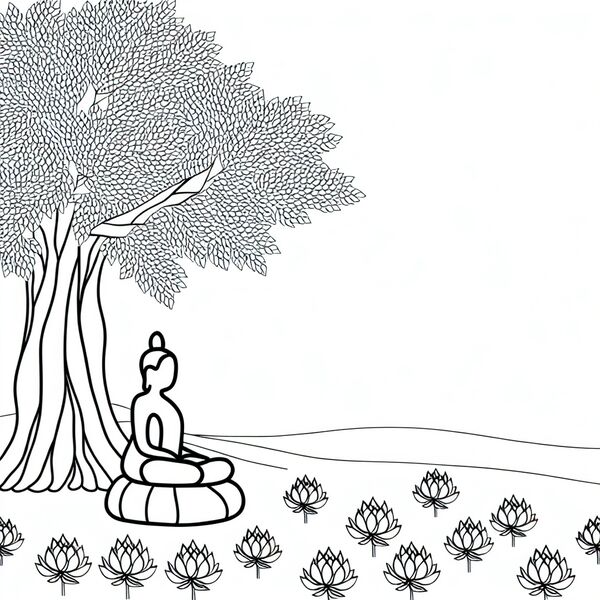
He ate the rice milk. His companions abandoned him. And Siddhartha, alone for what might have been the first time in his life, walked to a fig tree near modern-day Bodh Gaya and sat down.
"I will not get up from this seat until I have found the answer."
The Night That Changed Everything#
What happened under that tree is described differently depending on which tradition you ask. But the bones are the same: Siddhartha sat through the entire night and watched his own mind with the precision of a surgeon.
Mara showed up — the Buddhist personification of everything that keeps you asleep. Armies, seductions, existential doubt. "Who do you think you are to seek this?" Siddhartha touched the ground with his right hand and called the earth as his witness. No god. No scripture. Just: I have been sitting here, doing the work, and the ground I'm sitting on knows it.
Then, as the morning star rose, he saw it. The whole machine. How craving creates clinging, clinging creates identity, identity creates birth and death and the whole wheel turning again and again. He saw it the way you'd see the source code behind an app that's been running your life — and realized you could close it.
Siddhartha Gautama became the Buddha — "the one who woke up." He was 35. His first words, according to the Pali tradition:
"Through many a birth I wandered in samsara, seeking but not finding the builder of this house. O house-builder, you are seen! You will not build this house again. All your rafters are broken, your ridgepole is destroyed."
He sat under that tree for seven weeks. Then, reluctantly — because honestly, who would understand this? — he got up and walked to find his five former companions to tell them what he'd found.
They saw him coming and agreed not to show respect. He'd broken his ascetic vows. He was a quitter.
But as he got closer, something in the way he moved made them stand up despite themselves. And they listened.
Try this right now: Close your eyes for thirty seconds. Don't try to meditate. Just notice the first three things your mind does when you stop feeding it input. That restlessness? That itch to check your phone? The Buddha would call that the mind looking for its next hit. Just notice it. That noticing is the whole game.
The Diagnosis: Four Truths That Sound Simple Until They Wreck You#
The Buddha structured his core teaching like an ancient Indian doctor: symptom, cause, prognosis, treatment. Here it is.
Truth 1: Something is off.#
The Pali word is dukkha, and "life is suffering" is the worst translation in the history of translations. It's done more damage to Buddhism's reputation than every orientalist scholar combined.
Dukkha literally means an axle that doesn't sit right in the wheel — a wobble, a persistent unsatisfactoriness. Life isn't agony. Life is slightly off-center. You're at the best party of your life and there's a whisper in the back of your skull: this will end. You land the dream job and by Thursday you're thinking about the next promotion. You scroll through your phone for twenty minutes looking for something, put it down, and pick it back up eleven seconds later because you still didn't find it.
That's dukkha. Not the screaming kind. The quiet, gnawing kind that lives underneath every experience like a low-frequency hum you can't quite identify.
Truth 2: The wobble has a specific cause.#
It's called tanha — usually translated as "craving," but "thirst" is closer. Not ordinary wanting. You can want lunch without existential crisis. Tanha is that desperate, white-knuckled grip on things being different than they are. Wanting pleasure to never end. Wanting pain to stop right now. Wanting to be someone else. Wanting reality to match the version in your head.
Your mind is basically a Netflix algorithm that's convinced the next thing will finally satisfy you. One more episode. One more scroll. One more achievement. One more relationship. The algorithm never runs out of suggestions, and none of them work for more than fifteen minutes.
Truth 3: The wobble can stop.#
This is the line that makes Buddhism the most aggressively optimistic philosophy ever written, and almost nobody notices. It's not saying "someday, in heaven, after you die." It's saying: here, now, in this body, in this life, freedom is possible. The wheel can stop turning. The algorithm can be shut off.
Truth 4: Here's exactly how.#
It's called the Noble Eightfold Path, and it's not commandments from on high. It's a training program. Think of it in three clusters:
See clearly — Right View (understanding how suffering actually works) and Right Intention (pointing yourself toward compassion instead of accumulation).
Act clean — Right Speech (stop lying, gossiping, and tearing people down), Right Action (don't kill, steal, or cause harm), Right Livelihood (make money without making the world worse).
Train your mind — Right Effort (stop feeding the wolves that bite you), Right Mindfulness (pay attention to what's actually happening instead of the story you're telling about it), Right Concentration (learn to make your mind still enough to see clearly).
The word "right" here isn't moralistic. It's mechanical. "Right" the way a wheel is right when it spins true — bringing us full circle back to dukkha, the wobbling axle. The Eightfold Path is how you fix the wobble.
The Three Ideas That Quietly Rearrange Your Furniture#
Everything is on fire and that's fine.#
Impermanence — anicca — is Buddhism's most misunderstood teaching. People hear "nothing lasts" and think it's depressing. But sit with it for a while and something flips. If nothing lasts, then the terrible meeting you're dreading will end. The heartbreak will fade. The anxiety will pass. You are not stuck.
But the good stuff passes too, and that's where it gets you. Not as a punishment — as an invitation. If this cup of coffee, this conversation, this Tuesday morning won't come again, then maybe you should actually taste it. Impermanence isn't the enemy of joy. It's the thing that makes joy possible. A sunset that lasted forever would be furniture.
Try this: Next time something good is happening — really good, laughing-with-friends good — let yourself feel the faintest whisper of this will end without clenching against it. Don't push the thought away. Let it make the moment sharper. That's impermanence practice, and it will change how you experience everything.
You are not who you think you are.#
This is the one that breaks people. Anatta — no-self. The Buddha taught that there is no fixed, permanent, unchanging "you" at the center of your experience. What you call "me" is a constantly shifting pile of physical sensations, feelings, perceptions, mental habits, and moments of awareness — the five aggregates.
The classic analogy: Where is the "chariot"? The wheels? The axle? The platform? Take any piece away — still a chariot? Put all the pieces in a pile — chariot? "Chariot" is just a label we slap on a temporary arrangement of parts. Same with "you."
Here's a more modern version: You know how your computer feels like one unified thing, but it's actually millions of processes running simultaneously, and there's no central "computer" entity — just processes all the way down? That's you. The feeling of being a single unified self is the most convincing illusion in the universe, and you've been falling for it since birth.
This doesn't mean you don't exist. It means you don't exist the way you think you do — as some unchanging soul piloting a meat suit. You're more like a wave. Absolutely real. But not separate from the ocean.
The freedom in this is staggering once you stop panicking about it. If there's no fixed self, then you're not trapped being who you've been. The person who made those mistakes, who developed those habits, who carries that shame — that's a pattern, not a prison. Patterns can change.
Nothing exists alone.#
Pratītyasamutpāda — dependent origination. Nothing arises by itself. Everything is caused by everything else. Your anger right now? It exists because of a perceived slight, which arose from an expectation, which came from a belief about how you should be treated, which was installed by your parents, your culture, that one teacher in fifth grade. Zoom out far enough and your irritation about a rude email connects to everything that ever happened to you.
The practical power here is enormous: if suffering arises from conditions, and you can change conditions, you can change the suffering. You're not cursed. You're not broken. You're just running on causes and conditions that can be rearranged.
Four Stories That Hit Different#
Kisa Gotami and the Mustard Seed#
Kisa Gotami's baby died. Overwhelmed by grief, she carried the child through the streets, begging for medicine to bring him back. People didn't know how to help her. Someone sent her to the Buddha.
She fell at his feet: "Please. Medicine for my child."
The Buddha said: "Bring me a handful of mustard seeds from a house where no one has ever died."
She went door to door. Everyone had mustard seeds. Every single family had lost someone. A father. A daughter. A wife. By evening, something broke open inside her — not the grief, but the loneliness of it. She wasn't singled out. She was just human. She buried her child and came back. She didn't need the Buddha to explain anything. She'd learned it herself.
This story destroys me every time, because the Buddha didn't fix her pain. He fixed her isolation. The most healing thing in the world isn't the absence of suffering. It's the knowledge that you're not suffering alone.
The Serial Killer Who Couldn't Catch a Walking Man#
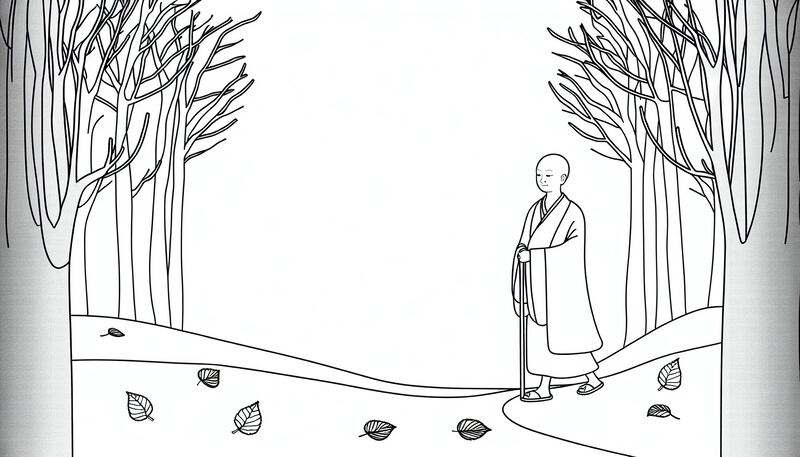
Angulimala — the name means "finger necklace" — was a serial killer wearing his victims' fingers around his neck. 999 fingers collected. He needed one more. He saw the Buddha walking alone on a road and charged after him.
But he couldn't catch up. The Buddha was just walking. Normal pace. And Angulimala, sprinting, couldn't close the distance.
"Stop! Stop!" he screamed.
The Buddha turned: "I have stopped. It is you who has not stopped."
One sentence. It cut through years of momentum, conditioning, violence. Angulimala dropped his sword and became a monk. The villagers still threw rocks at him when he walked through town — past actions have consequences that don't evaporate — but he took it without flinching.
The message isn't "forgive and forget." It's: your past is real, but it doesn't own your future. You can stop running at any moment. Even this one.
The Overflowing Cup#
A university professor visited Zen master Nan-in and wouldn't stop talking. His theories about Zen, his publications, his opinions. Nan-in poured tea into the professor's cup. Kept pouring. Tea overflowed onto the table, the floor.
"It's full! No more will go in!"
"Like this cup, you are full of your own opinions. How can I show you anything unless you first empty your cup?"
I think about this every time I open Twitter. Every time I walk into a conversation already knowing what I think. Every time I read a book just to confirm what I already believe. The cup is always full. The practice is learning to pour some out.
The Arrow (Or: Please Stop Asking About the Multiverse)#
Someone once cornered the Buddha with a chain of metaphysical questions. Is the universe eternal? Infinite? Does the self survive death?
The Buddha said: Imagine a man shot with a poisoned arrow. His friends bring a surgeon, but the man says: "Don't remove the arrow until I know whether the man who shot me was tall or short, what caste he was from, what kind of bow he used..."
That man would die with the arrow still in him.
This is Buddhism's most savage moment. Every time you disappear into abstract debate instead of dealing with what's actually hurting you — every time you read another self-help book instead of sitting with the discomfort, every time you build another theory about why you're unhappy instead of just being present with the unhappiness — you're the man with the arrow, asking for the archer's biography.
Try this: Think of one thing you've been intellectualizing instead of feeling. One problem you've been analyzing to death instead of sitting with. For sixty seconds, stop thinking about it and just feel what it feels like in your body. Where does it live? What's its texture? That's removing the arrow.
"But Isn't Buddhism Just Nihilism With Better Branding?"#
No, and the Buddha would be annoyed you asked. He explicitly rejected nihilism — uccheda-vada — as one of two extreme wrong views (the other being eternalism, the belief in a permanent soul).
Here's what actually ceases in nibbana: not you. The craving. The clinging. The burning. The Buddha's favorite metaphor was fire going out. And in ancient Indian thought, fire that went out wasn't destroyed — it was released. Freed from the fuel that trapped it.
Nibbana isn't nothingness. It's what's left when you stop being on fire all the time.
"But isn't it passive?"
Tell that to Ambedkar, who led millions of Dalits out of caste oppression through Buddhist conversion. Tell that to Thich Nhat Hanh, who walked into the Vietnam War and pulled wounded people from rubble on both sides. Tell that to the monks in Myanmar and Tibet who set themselves on fire to protest injustice.
The Buddha didn't teach passivity. He taught non-reactivity, which is the opposite. Reactivity is being a pinball — bounced from stimulus to stimulus with no choice. Non-reactivity is the gap between the stimulus and your response, where freedom lives. That's not weakness. That's the most dangerous kind of strength, because it can't be provoked.
"It's just 'life sucks, deal with it,' right?"
If that's what you heard, you read the first Noble Truth and stopped. The whole arc goes: diagnosis → cause → prognosis → treatment plan. It's not "life sucks." It's: "There's a specific wobble. It has a specific cause. The cause can be removed. Here are the exact steps." That's not pessimism. That's an engineering manual for the mind.
Your Mind on 2,500 Years of R&D#
Buddhism predicted several things that modern science is just catching up to.
Neuroscientist Richard Davidson at the University of Wisconsin scanned the brains of long-term meditators and found they have measurably thicker prefrontal cortexes, more activity in regions associated with positive emotions, and reduced amygdala reactivity. The Buddhist claim that the mind can be trained like a muscle turns out to be literally, neurologically true.
Cognitive Behavioral Therapy — the most evidence-based talk therapy we have — is structurally identical to Buddhist thought: suffering comes not from events but from your interpretation of events. Aaron Beck, CBT's founder, acknowledged the parallel. Marsha Linehan, who created Dialectical Behavior Therapy, is a Zen practitioner. Acceptance and Commitment Therapy explicitly incorporates mindfulness. The West spent a century reinventing a wheel that was already spinning in 500 BCE.
And the Buddhist concept of anatta — no fixed self — maps almost perfectly onto what neuroscience now says about consciousness: there is no single "self" center in the brain. Just overlapping networks of processes producing the illusion of a unified experiencer. The Buddha saw this by sitting still and looking inward. We needed fMRI machines.
A Practice Guide for People Who Won't Move to a Monastery#
You don't need robes, a shaved head, or even the word "Buddhist." You need ten minutes and the willingness to be bored.
Weeks 1-2: Just Sit#
Ten minutes. Comfortable position. Timer set. Eyes closed. Attention on the breath — the physical sensation at your nostrils, or your belly rising and falling. Your mind will wander approximately four hundred times. Each time, notice it wandered, and come back. That's the whole practice. The wandering isn't failure. The noticing is the exercise. It's a bicep curl for attention. Nobody gets mad at a bicep curl for being heavy.
Weeks 3-4: Catch the Wobble#
Throughout your day, start noticing dukkha in the wild. You get what you wanted and immediately want the next thing. You finish a meal and start planning the next one. You check your phone, put it down, and pick it up twelve seconds later. Don't judge it. Just catch it. "Oh. There you are." That recognition — the moment you see the pattern — is the beginning of not being run by it.
Weeks 5-6: The Impermanence Game#
When something unpleasant happens — a traffic jam, a harsh email, a headache — whisper to yourself: "This is temporary." When something beautiful happens — a great song, a perfect bite of food, sunlight on your face — also: "This is temporary." Not to ruin it. To sharpen it. To drink it with both hands because it won't come again.
Weeks 7-8: Loving-Kindness (Yes, It's Corny. Do It Anyway.)#
Sit quietly. Repeat: "May I be happy. May I be safe. May I be healthy. May I live with ease." Then aim those phrases at someone you love. Then someone neutral — the barista, the mail carrier. Then someone who annoys you. Then everyone, everywhere.
This will feel ridiculous for about two weeks. Then something shifts and it becomes the most powerful practice you do. Give it the two weeks before you judge.
Ongoing: Read One Dead Person Slowly#
Pick up the Dhammapada, or Thich Nhat Hanh's The Heart of the Buddha's Teaching, or Pema Chödrön's When Things Fall Apart. Read one page. Sit with it. Not as an academic exercise — as a conversation with someone who thought about the same 3 AM problems you have, just 2,500 years earlier.
When You're Ready: Sit With Others#
Find a local sitting group — Zen center, Theravada temple, secular mindfulness group. Something happens in shared silence that doesn't happen alone. The sangha — the community — is one of Buddhism's Three Jewels for a reason.
A Morning That Doesn't Start With Your Phone#
Here's a daily structure borrowed from 2,500 years of practice and adapted for someone with a job and a smartphone addiction:
Morning: Wake up. Don't touch your phone. (I know. I know. Try it for three days.) Lie still for thirty seconds and feel what it's like to exist without input. Take three slow breaths. Set one intention: "Today I'll try to pay attention." Sit for ten minutes. Read one paragraph of something that wasn't written for clicks.
Throughout the day: Several times, just stop. Stop, take one breath, notice what you're feeling, and continue. Eat one meal without a screen — actually taste the food, notice the textures, think about the chain of human effort that brought it to your plate. Before you speak, run it through four filters: Is it true? Is it kind? Is it necessary? Is this the right time? (You'll be amazed how much you don't say.)
Evening: Review the day without judgment — just curiosity. Where did you react on autopilot? Where were you actually present? Send some silent kindness to anyone who annoyed you today. Then: "Whatever good came from today, may it benefit everyone." This is a traditional Buddhist practice called dedicating the merit, and it's a surprisingly effective way to end a day without the usual doom-scroll into unconsciousness.
Where to Go Deeper#
Start here: What the Buddha Taught by Walpola Rahula. Under 200 pages. No jargon. Written by a Sri Lankan monk who respects your time.
For the heart: The Heart of the Buddha's Teaching by Thich Nhat Hanh. Makes the Four Noble Truths feel like a love letter.
For when everything's falling apart: When Things Fall Apart by Pema Chödrön. Not theory. Survival.
For the original voice: In the Buddha's Words by Bhikkhu Bodhi. An anthology from the actual Pali Canon, beautifully organized. This is the Buddha speaking, not someone speaking about the Buddha.
For beginners' mind: Zen Mind, Beginner's Mind by Shunryu Suzuki. Every sentence is worth ten minutes of silence.
For the novel: Siddhartha by Hermann Hesse. Not historically accurate. Emotionally perfect.
The Last Thing#
Here's what gets me about Buddhism.
Every other philosophy I've studied feels like it's handing you something — a framework, a worldview, a set of beliefs to carry around. Buddhism is the only one that says: put it all down. You don't need more ideas. You need fewer. Enlightenment isn't something you gain. It's what's already here when you stop piling things on top of it.
The Buddha wasn't a god. He wasn't a prophet. He was a man who sat very still and looked very closely at the nature of his own mind. And he found that the looking itself — that bare, unflinching attention — was the liberation.
Twenty-five hundred years later, you're sitting in roughly the same kind of body, running roughly the same kind of mind, drowning in roughly the same kind of craving. The only difference is that now the cravings arrive at the speed of fiber optic cable and the distractions are engineered by billion-dollar companies.
The practice is the same. Sit down. Shut up. Pay attention to what's actually happening.
Everything else is the man with the arrow, asking for the archer's shoe size.
"A jug fills drop by drop." — The Buddha, Dhammapada
Talk about it · 4 questions
- Why did Siddhartha leave his palace, and what did he hope to find?
- What did Kisa Gotami learn from searching for the mustard seed?
- Is Buddhism a religion, a philosophy or a method? Give reasons.
- The Buddha told the parable of the arrow. What questions does it say to set aside?