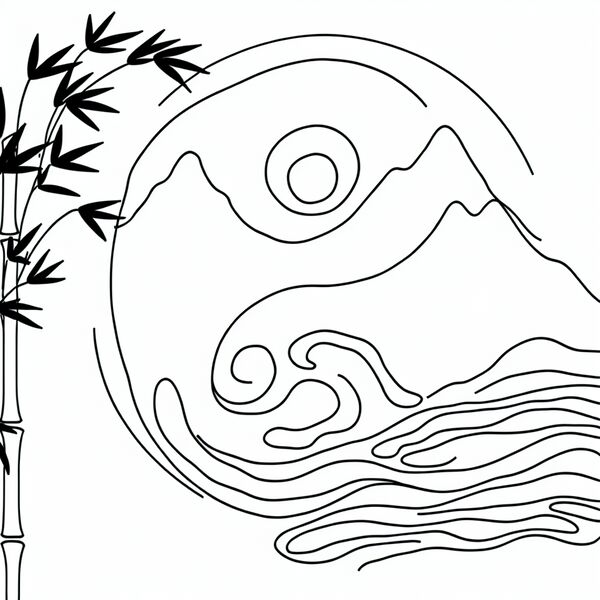
The Saffron Wing · Eastern Traditions
Taoism
Stop pushing the river. It was flowing fine without you.
An old librarian watched China tear itself apart, climbed on a water buffalo, and disappeared — leaving behind 5,000 words that might be the most dangerous thing you'll ever read. Taoism is the 2,500-year-old reminder that the most powerful force in the universe looks like doing nothing at all.
In 5 minutes
Taoism teaches living in harmony with the natural flow of things, acting without forcing, like water.
- The Tao is the way of nature, which cannot be fully put into words.
- Wu wei means effortless action — working with things, not against them.
- Softness and yielding, like water, can overcome what is hard.
Try today: Notice one moment today where you are forcing something. Pause, breathe, and try the gentler way.
Jump to the practiceBefore you go in…
One small question at the door. No right answers, just yours, and then how Taoism would reason about it.
You're burning out. The obvious fix is a better system: a new app, an earlier alarm, a stricter plan. Or is the fix to subtract something instead?
You're reading this because something isn't working.
Maybe it's your career. Maybe it's a relationship. Maybe it's that 2 AM feeling where you're staring at the ceiling wondering why you're so tired all the time despite doing everything "right." You followed the plan. You hustled. You optimized your morning routine, tracked your habits, read the productivity books. And somehow, the harder you grip, the more life squirts out between your fingers like wet soap.
Twenty-five hundred years ago, an old librarian in China watched an entire civilization make the same mistake. And then he climbed on a water buffalo and disappeared.
He left behind 5,000 words that might be the most dangerous thing you'll ever read.
The Librarian Who Walked Away From Civilization#
Here's the setup. Sixth century BC. China is a dumpster fire. The Zhou dynasty has shattered into dozens of warring states. Warlords, assassinations, political backstabbing — think Game of Thrones but with more bureaucracy and fewer dragons. Every intellectual in the country is shouting about how to fix things.
In the middle of this mess, there's a guy working in the royal archives. His name — or his title, nobody's really sure — is Laozi. The Old Master. He catalogues scrolls. He reads ancient texts. He watches the world tear itself apart and keeps his mouth shut.
He's so quietly strange that when Confucius — the most famous thinker in China, the guy who wants to fix society through ritual and duty and people being properly respectful to each other — comes to visit him, Confucius walks out looking like he just saw a ghost.
"I know a bird can fly," Confucius tells his students afterward. "I know a fish can swim. But the dragon — I cannot fathom it. Today I have met Laozi, and he is like a dragon."
Not fierce. Not terrifying. Just... operating on a frequency Confucius couldn't tune into.
And then Laozi does something that still messes with me.
He quits. Not just his job. He quits civilization.
He looks at all these brilliant people screaming at each other about the right way to organize society, and he decides the whole project is the problem. He climbs on a water buffalo — not a war horse, not a chariot, a water buffalo, the slowest possible exit — and heads west toward the mountains.
At the border, a gatekeeper named Yinxi stops him. "Master, you're leaving forever. At least write something down."
So Laozi sits down and bangs out 81 short chapters. Five thousand Chinese characters. The whole thing is shorter than most blog posts you've bookmarked and never read. He hands it over, gets back on his water buffalo, and rides into the mountains.
Nobody sees him again. No forwarding address. No farewell tour. The original Irish exit.
That slim text is the Tao Te Ching — The Book of the Way and Its Power. It's been translated more than any book on earth except the Bible. And it starts with the most audacious opening line in the history of philosophy:
"The Tao that can be told is not the eternal Tao."
Translation: the thing I'm about to spend 5,000 words describing? Words can't actually describe it. Good luck.
Try this right now: Think of the best moment of your life. The happiest, most alive, most real moment. Now try to explain it to someone. Notice how the words are always slightly wrong? How the description is never quite the experience? That gap — that's what Laozi is pointing at. The most real things resist language. Hold onto that feeling. You'll need it.
Everyone Was Yelling. One Guy Shrugged.#
To get why Taoism hits different, you need the context.
Ancient China's Spring and Autumn period was an intellectual cage match. The old order had collapsed, everything was chaos, and every philosopher had a fix. The Chinese call this era the "Hundred Schools of Thought" — a golden age of ideas born, as golden ages always are, from everything going horribly wrong.
Confucius said: More rules. More rituals. More respect for hierarchy. If everyone just did their duty, society would heal.
The Legalists said: Forget morality. Strict laws, harsh punishments. People are selfish animals — treat them accordingly.
The Mohists said: Universal love! Practical engineering! Stop fighting and build stuff!
And then the Taoists walked in, looked at all these elaborate plans to fix the world, and said: What if the fixing is the problem?
Not out of laziness. Not out of nihilism. But from a genuinely unsettling observation: most of our suffering comes from our frantic, sweaty-palmed attempts to control things that were doing just fine without our input.
You know this feeling. You've lived it. That group project where the more everyone "managed" it, the worse it got — until someone finally said "let's just each do our part" and suddenly it came together in a weekend. That relationship where you tried so hard to make it work that you strangled the life out of it. That night of insomnia where sleep only came the moment you stopped trying to fall asleep.
The Taoists looked at the universe and saw something the fixers missed: it already has a rhythm. Seasons turn. Rivers find the sea. Seeds become trees without project managers. The question isn't how to impose order on chaos. The question is how to stop imposing disorder on a cosmos that was handling things before you showed up.
That rhythm, that pattern, that underlying intelligence running through everything?
They called it the Tao.
The Five Ideas That Will Quietly Ruin Your Life (In a Good Way)#
1. The Tao — The Thing You Can't Google#
The word "Tao" literally means "path" or "way." But in practice, it points to something you can feel but never pin down — the fundamental grain of reality. The operating system running beneath everything.
Here's my favorite way to think about it. You know how the best code writes itself? How experienced programmers talk about "elegant" solutions that feel discovered rather than invented, like the logic was already there waiting to be uncovered? That's Tao. It's not a god. It's not a force. It's more like... the way things naturally work when nobody's screwing them up.
Your body heals a cut without you supervising. Your lungs breathe while you sleep. A river carves a canyon with no blueprint. A murmuration of starlings moves as one organism with no leader. Something is coordinating all of this, and it isn't your conscious mind.
Laozi's radical claim is that this same intelligence runs through your life — through your decisions, relationships, creative work, everything. And the main thing blocking it is you. Your plans. Your opinions. Your desperate need to be in charge.
"The Tao that can be told is not the eternal Tao. The name that can be named is not the eternal name."
The menu is not the meal. The map is not the territory. And this article is not the Tao. (Sorry.)
2. Wu Wei — The Art of Getting Out of Your Own Way#
This is the concept that changes lives. I'm not being hyperbolic. This one idea, really understood, can restructure how you move through the world.
Wu wei (無為) gets translated as "non-action" or "non-doing," and every Western reader immediately pictures someone on a couch watching Netflix and calling it enlightenment. Wrong.
Wu wei is action in perfect alignment with the moment. It's doing without forcing. Working without struggling. It's the difference between pushing a boulder uphill and finding the slope where it rolls itself.
Here are some things that are wu wei:
- That conversation where you stopped rehearsing what to say next and suddenly everything flowed — you were funnier, warmer, more you than the version of yourself you'd been performing.
- The athlete who stops thinking and starts playing. The musician who closes their eyes and the song plays them.
- That afternoon where you gave up on the problem, went for a walk, and the solution appeared fully formed in your head before you reached the corner.
- Falling asleep. (You literally cannot try to fall asleep. Trying is what keeps you awake.)
Wu wei is what happens when you get out of your own way. Not when you stop caring — when you stop interfering.
Try this today: Pick one thing you're currently white-knuckling. A project, a conversation you've been rehearsing, a decision you keep churning on. Now stop. Genuinely stop working on it. Go do something else entirely. Walk. Cook. Shower. Watch what happens in the space you just created. The answer often shows up the moment you stop interrogating the universe for it.
3. Water — The Softest Thing That Destroys Everything#
Laozi was obsessed with water. He couldn't shut up about it. And honestly? He was onto something.
"Nothing in the world is as soft and yielding as water. Yet for dissolving the hard and inflexible, nothing can surpass it."
Water doesn't fight. It doesn't have a strategy. It just keeps being water. It flows around obstacles. It finds the lowest point. It seeps into cracks. Given enough time, it carves the Grand Canyon, erodes mountains, shapes continents. Not through force. Through persistence and flexibility.
This is the Taoist model of power, and it's the exact opposite of what we're taught. We're taught that strength means hardness. Be tough. Be firm. Don't bend. But Laozi points out something you already know: the rigid tree snaps in the storm while the flexible reed survives.
Think about the toughest people you know. The ones who white-knuckle through every crisis, who refuse to bend, who pride themselves on being "strong." How are they doing? Really? Because in my experience, they're the ones who shatter. The people who last — the ones still standing at 70, 80, still creating, still curious — are the ones who learned to bend.
A man is born soft and supple. At death he is hard and stiff. Flexibility is life. Rigidity is death.
Micro-practice: Next time you hit resistance — an argument, a stuck project, a door that won't open — stop pushing harder. Ask: where is the water going? Where's the crack, the gap, the path of least resistance that isn't laziness but intelligence?
4. Yin and Yang — Everything Is Becoming Its Opposite#
You've seen the symbol. It's on dorm room posters, surf shop t-shirts, and at least one tattoo you regret. But most people get it completely wrong.
Yin and yang are not good versus evil. They're not even opposites in the way you think. They're dance partners. Each one creates the other, defines the other, and is already becoming the other.
The little dot of white inside the black, the dot of black inside the white — that's the whole point. At the peak of summer, winter is already being born. In your darkest moment, recovery is already germinating. After the best meal of your life, hunger is coming.
This isn't pessimism or optimism. It's just... physics. Emotional physics.
And the practical upshot is strangely calming: don't cling to the good times (they'll change) and don't despair in the bad times (they'll change too). Just... watch the wheel turn. Ride it. Don't grab the spokes.
Try this when things are terrible: Instead of fighting the darkness, look for the tiny white dot. Where is the seed of something new growing inside this mess? It's always there. Breakups teach you what you actually need. Job losses open doors you wouldn't have walked through voluntarily. The crack is where the light gets in. (Leonard Cohen was a Taoist and didn't know it.)
5. Pu — You Were Fine Before the World Got to You#
Pu (朴) means "uncarved block." A piece of raw wood before anyone shapes it into a chair or a spoon or a decorative figurine for a middle manager's desk.
It represents your original nature. Before society told you what to want. Before Instagram set your beauty standards. Before LinkedIn made you feel behind. Before you learned that your worth was a function of your productivity.
Taoism's quietly radical claim: you were complete before any of that. The uncarved block is whole. It doesn't need to be improved. It needs to be uncovered — all the layers of conditioning stripped away until you find the person who was there before the world started carving.
This is why Taoism has an almost subversive relationship with self-improvement culture. Most self-help says: you're broken, here's how to fix yourself. Taoism says: you're not broken. You've just forgotten what you are underneath all the fixing.
Micro-practice: Catch yourself performing today. Notice the moment you say something because it'll sound good rather than because it's true. Notice when you do something to be seen doing it rather than because you want to. Each time you notice, you've scraped away a little bit of the carving. The block underneath is still there.
Four Stories That Will Haunt You#
Taoism doesn't argue. It doesn't build syllogisms. It tells stories that crawl into your brain at 2 AM and won't leave.
The Butterfly Dream#
One night, Zhuangzi dreamed he was a butterfly. Not a guy dreaming about a butterfly — he was a butterfly. Fluttering around, ecstatic, with absolutely no concept of anyone named Zhuangzi. Then he woke up. And he was Zhuangzi again.
But here's where it gets weird. He couldn't shake this question: "Am I a man who just dreamed he was a butterfly? Or am I a butterfly right now, dreaming it's a man?"
This story is 2,300 years old and it still slaps. The Wachowskis put it in The Matrix (red pill, anyone?). Philip K. Dick spent his entire career writing variations of it. And it's not just a clever riddle — it's a live grenade thrown at the foundations of everything you think you know.
How solid is your identity? How certain are you that this — right now, reading these words — is the "real" version? You spend a third of your life in dreams that feel completely real while you're in them. You only know they were dreams after you wake up.
Zhuangzi isn't trying to give you an anxiety attack. He's trying to loosen the grip. To make you hold your identity, your certainties, your whole constructed self just a little more lightly. Because the lighter you hold it, the freer you are.
Cook Ding and the Ox#
Cook Ding was butchering an ox for Lord Wen-hui. But "butchering" is the wrong word. His knife moved like music — zip, slice, whoosh — and the meat fell away from the bone the way your coat falls off your shoulders when you get home.
Lord Wen-hui watched with his mouth open. "How?"
Cook Ding set down his knife. "When I started, all I could see was the ox. After three years, I stopped seeing the ox. Now I go by spirit. My senses stop and my spirit moves where it wants. I follow the natural structure. I guide the knife through the openings."
Then the flex: "A good cook changes his knife every year — because he cuts. A mediocre cook changes his knife every month — because he hacks. I've had this knife for nineteen years. The blade has no thickness. The joints have spaces. Insert what has no thickness into where there is space — there's plenty of room."
This story isn't about cooking. (Obviously.) It's the blueprint for everything.
Every domain has a grain — an invisible structure of openings and joints. Your career has one. Your relationships have one. That creative project you're stuck on has one. Most people hack. They force the blade. They attack the bone head-on and then wonder why their knife is dull and their arms are tired.
The master finds the spaces. And their blade stays sharp for nineteen years.
Try this: Whatever you're working on right now — where are you hacking? Where are you grinding against the bone? Stop. Step back. Feel for the joint. The space. The place where the blade slides through with no resistance. It's there. You just can't find it while you're forcing.
The Crooked Tree#
Zhuangzi and his friend Huizi come across an enormous tree with a trunk so gnarled and branches so twisted that a passing carpenter doesn't even slow down. "Useless," the carpenter mutters. "Can't make anything out of that."
Zhuangzi grins. "This tree has survived for centuries because it's useless. Every straight, beautiful tree got cut down long ago — turned into lumber, furniture, chopsticks. This one, because nobody could use it for anything, grew old and enormous and magnificent. Its 'uselessness' was its salvation."
Read that again if you need to, because it's aimed directly at the part of you that's terrified of being useless.
How many people burn themselves to ash trying to be useful? How many of your best qualities — your weirdness, the way your brain works sideways, the things that don't fit on a résumé — are actually the things that'll let you grow old and magnificent?
Hustle culture is a sawmill. It identifies the straight, useful trees and turns them into lumber. The crooked ones? The ones who can't be easily used? They survive. They grow enormous. They become the landmarks.
Ask yourself: What's the "crooked" part of you that you keep trying to straighten? What would happen if you stopped?
The Empty Boat#
You're rowing across a river. Another boat slams into yours. You're furious. You spin around to scream at the idiot who—
The boat is empty. It just drifted into you. No one's steering it.
And suddenly? No anger. You just push it away and keep rowing.
Zhuangzi's point lands like a freight train: the anger was never about the collision. It was about the person. Remove the ego — the story of someone doing this to you — and the collision is just a collision. Something that happened. Something you handle and move on from.
"If you can empty your own boat crossing the river of the world, no one will oppose you, no one will seek to harm you."
Most of your suffering isn't caused by what happens to you. It's caused by the story you tell about who did it and why. The empty boat isn't just a thought experiment. It's maybe the single most useful reframe in all of philosophy.
Start tonight: When someone cuts you off in traffic, sends a passive-aggressive email, or leaves their dishes in the sink again — pause. Empty boat. Their behavior is weather. It's an empty boat bumping into yours. Can you just... push it aside and keep rowing?
"But Isn't This Just Laziness?" (And Other Objections That Miss the Point)#
The Laziness Accusation#
Every time someone encounters wu wei, some guy in the back goes: "So... you just do nothing? Cool philosophy, bro."
No. Wu wei is harder than brute force. It requires more attention, more sensitivity, more patience. A surfer doesn't just sit in the ocean. She reads the swell for hours, paddles into exact position, then moves with explosive precision at the only moment that matters. That's wu wei. The timing, the reading, the waiting — that's the work. The ride is what it looks like when the work pays off.
Lazy people don't wait for the right moment. They avoid all moments equally.
"This Is Just Mystical Woo"#
Zhuangzi was one of the sharpest logicians in Chinese history. His arguments are philosophically rigorous, layered with irony, and they still stump graduate students. He just also recognized something Western philosophy took another 2,000 years to figure out: logic has limits. Your rational mind is a phenomenal tool and a terrible master. Taoism isn't anti-intellectual. It's anti-only-intellectual. Use your mind, but don't let it use you.
"It's a Chinese Thing, It Doesn't Apply to Me"#
Wu wei maps almost perfectly onto what psychologist Mihaly Csikszentmihalyi calls "flow." The Taoist emphasis on accepting what you can't control echoes Stoicism so closely that Marcus Aurelius could've blurbed the Tao Te Ching. The yin-yang principle shows up in every physics textbook as the interplay of opposing forces. Taoism speaks in Chinese, but its observations are about being human. Last I checked, that's not a regional experience.
Taoism in 2026 (Or: Why a 2,500-Year-Old Philosophy Is Having Its Moment)#
Your Burnout Has a Cure and You Won't Like It#
Here's the uncomfortable truth Taoism offers the productivity-obsessed: you're not burned out because you're not doing enough. You're burned out because you're doing too much of the wrong things in the wrong way.
Chapter 48 of the Tao Te Ching: "In pursuit of learning, every day something is acquired. In pursuit of Tao, every day something is dropped."
Wisdom isn't accumulation. It's subtraction. Not another app, another system, another morning routine. Just... dropping the things that don't serve you. The meetings that could be emails. The goals that aren't actually yours. The identity you've been maintaining for people you don't even like.
On Reddit's r/taoism, someone posted a thread titled "Depression, Taoism, and the Tyranny of Should" that blew up. The core insight: depression often comes from the gap between what you are and what you think you should be. I should be further along. I should be more disciplined. I should want what successful people want. These "shoulds" aren't natural. They're installed. The Tao Te Ching doesn't deal in shoulds. It deals in what is.
And in that shift — from "should" to "is" — an enormous amount of suffering just... evaporates.
(This isn't a replacement for therapy or medication. It's a cognitive reframe. A powerful one, but not a replacement.)
The Best Leaders Are Invisible#
Chapter 17: "The best leaders, the people do not notice. When the best leader's work is done, the people say, 'We did it ourselves.'"
Every manager who's ever micromanaged a team into the ground should have this tattooed on their forearm. The Taoist leader doesn't direct — they create conditions. They don't motivate — they remove obstacles. They don't take credit — they make other people feel like geniuses.
Silicon Valley keeps "discovering" this every five years and slapping a new label on it. Servant leadership. Flat hierarchies. "Getting out of your team's way." Laozi wrote the playbook 2,500 years ago in 40 words. We just keep losing it and finding it again.
Creativity Doesn't Respond to Force#
Every writer, musician, and artist knows the paradox: the harder you try, the worse it gets. Creativity is the most Taoist of human capacities. It doesn't come when you call it. It comes when you stop calling and start listening.
The blank page is terrifying when you're trying to write something brilliant. It's fertile when you're just curious about what wants to emerge. The song comes when you stop trying to write a hit. The painting works when you stop trying to make art. This isn't mysticism — ask any creative professional and they'll nod so hard they'll hurt their neck.
The Other Voice: Zhuangzi, the Trickster Sage#
If Laozi is the sage who ghosted civilization, Zhuangzi (roughly 369–286 BC) is the sage who stuck around to mess with it.
Where Laozi is cryptic and poetic, Zhuangzi is wild, funny, and infuriating. He argues with his best friend about whether fish are happy. He turns down a government position by comparing it to being a sacred tortoise — honored, sure, but dead and shellacked. He'd rather be a live turtle dragging his tail in the mud.
If Laozi wrote the scripture, Zhuangzi wrote the standup special.
His book, the Zhuangzi, is the other pillar of Taoist philosophy. Where the Tao Te Ching gives you principles, the Zhuangzi gives you stories, jokes, and paradoxes that detonate inside your head days after you read them. The butterfly dream. Cook Ding. The crooked tree. The empty boat. All Zhuangzi.
His masterpiece is the concept of the equality of things — the idea that all our judgments (good/bad, beautiful/ugly, useful/useless) are arbitrary, perspective-dependent, and ultimately imprisoning. We live inside a cage of categories we built ourselves, and we've lost the key. Zhuangzi's entire body of work is one long, hilarious lockpicking tutorial.
"Happiness is the absence of the striving for happiness."
That's a popular modern paraphrase rather than a line from the Zhuangzi itself — but it's Zhuangzi's idea in one line. The paradox that sets you free.
The Vinegar Tasters (Or: Taoism vs. Everyone Else in One Image)#
There's a famous Chinese painting called The Three Vinegar Tasters. Three old men stand around a vat of vinegar. Each has dipped a finger in and tasted it.
Confucius looks sour. Life has gone wrong. People have strayed from the proper way. Everything needs correcting.
The Buddha looks bitter. Life is suffering. Attachment is the cause. Transcendence is the only escape.
Laozi is smiling.
Not because he's naive. Not because he's pretending things are fine. But because he sees life in its raw, unfiltered, unedited state as fundamentally okay. The sourness and bitterness come from our judging, interfering, endlessly dissatisfied minds. Life itself — wild, messy, unpredictable, unreasonable life — tastes sweet to the one who stops demanding it taste like something else.
One painting. Three entire worldviews. And you get to pick which face you're making.
Your Taoist Toolkit: Practices That Actually Work#
I've woven practices throughout this piece, but here's a concentrated hit.
The Morning Non-Routine#
Don't reach for your phone. (I know. I know.) Just don't. For the first ten minutes of your day, just exist. Sit. Breathe. Watch the light change. You're not meditating — you don't have to do it right. You're practicing being alive without an agenda. Drink your coffee like it's the only thing happening in the universe.
The Wu Wei Check-In#
Three times a day, ask yourself: "Am I flowing or forcing right now?" That's it. You don't have to change anything. Just notice. The noticing alone starts to shift things — like how you drive better the moment you realize you've been drifting lanes.
The Weekly Emptying#
Once a week, cancel something. Drop something from your to-do list that doesn't actually need doing. Not the important stuff — the stuff you do out of habit, obligation, or the vague feeling that you "should." In pursuit of Tao, every day something is dropped. Start with once a week.
The Nature Prescription#
Go outside. Not with a podcast. Not with a step count. Just go. Sit by any body of water — a pond, a stream, a puddle — and watch it for ten minutes. You'll understand more about wu wei from that puddle than from this entire article. I mean it.
The Zhuangzi Nightcap#
Before bed, read one chapter of the Tao Te Ching (there are 81 — that's nearly three months). Don't analyze it. Don't take notes. Let it land wherever it lands. Some chapters will mean nothing. Some will hit you like a truck. Trust the process.
Where Taoism Touches Everything Else#
Taoism → Zen Buddhism. When Buddhism migrated from India to China, it slammed into Taoism and produced Chan Buddhism — which became Zen in Japan. Zen's obsession with direct experience, its paradoxical koans, its deep suspicion of conceptual thinking — that's Taoism's DNA in Buddhist clothing. If you love Zen, you were already a Taoist. You just didn't know it.
Taoism → Stoicism. Marcus Aurelius and Laozi never met, but their books could share a shelf and finish each other's sentences. Accept what you can't control. Respond rather than react. Live according to nature. The main difference: Stoicism tries to think its way to peace. Taoism tries to stop thinking its way to peace.
Taoism → Flow Psychology. Csikszentmihalyi's flow states are wu wei with brain scans. Complete absorption, ego dissolution, action and awareness merging. Every programmer who's lost four hours in a coding trance, every surgeon who operates in a state of total presence, every skateboarder who lands a trick they never consciously planned — that's wu wei wearing a lab coat.
Taoism → Martial Arts. Tai chi, qigong, aikido — the "soft" arts where you use your opponent's force against them, where yielding defeats aggression, where the flexible outlasts the rigid. Straight out of the Tao Te Ching. Bruce Lee's "be water, my friend" isn't a metaphor. It's Taoist philosophy compressed into five words.
The Books That Actually Matter#
Start here: Tao Te Ching — get either the Stephen Mitchell translation (poetic, clean, the one that made it a modern classic) or Ursula K. Le Guin's version (spare, luminous, slightly feminist — she spent decades on it and it shows).
For Zhuangzi: Burton Watson's The Complete Works of Zhuangzi. Watson captures the humor. You'll laugh and then realize you're thinking about it in the shower three days later.
For the skeptic: Trying Not to Try by Edward Slingerland. Takes wu wei and connects it to neuroscience and psychology. Rigorous enough for the rationalists, readable enough for everyone else.
For the curious: Tao: The Watercourse Way by Alan Watts. Watts's final book. Part philosophy, part nature writing, part love letter. Published after his death. Gorgeous.
For the playful: The Tao of Pooh by Benjamin Hoff. Winnie the Pooh as a Taoist master. Sounds absurd. Works perfectly. Best gateway drug in the genre.
For the adventurous: The Way of Chuang Tzu by Thomas Merton. A Catholic monk interpreting Taoist stories. The collision of traditions produces something electric.
Your First Week (A Dare)#
Day 1: Read the first ten chapters of the Tao Te Ching. Don't study them. Let them wash over you like background music. See what sticks.
Day 2: Go for a walk with no phone and no destination. Notice water — puddles, streams, condensation on a window. How does it move? What does it avoid?
Day 3: Pick one thing you're forcing. Stop. Do nothing about it for 24 hours. Just watch what happens in the space.
Day 4: Read the Butterfly Dream and Cook Ding stories (they're in the Zhuangzi, or just Google them). Don't interpret them. Sit with them.
Day 5: Practice the Empty Boat. When someone irritates you, imagine their behavior as an empty boat that drifted into yours. Watch what happens to the anger.
Day 6: Be useless for 30 minutes. No phone. No goals. No productivity. Just exist. Notice how physically uncomfortable this is. Notice what opens up when you survive it.
Day 7: Read ten more chapters. Write down the one line that hits hardest. Put it somewhere you'll see it every day.
The River Doesn't Need Your Help#
There's a reason Laozi chose a water buffalo and not a war horse. There's a reason he headed for the mountains and not another palace. There's a reason the Tao Te Ching is 5,000 characters and not 500,000.
Everything in Taoism points to the same thing: you are trying too hard at the wrong things. You are pushing a river that already knows where it's going. You are clenching your fist around water and wondering why it keeps slipping away. You are lying in bed trying to fall asleep, which is exactly why you can't.
The river doesn't need your help. It was flowing before you got here. It'll flow long after you're gone.
Your only job — the only job that was ever really yours — is to stop pretending you're the one who has to push the water.
Let go.
Float.
See what happens.
"Muddy water, let stand, becomes clear." — Tao Te Ching, Chapter 15
Talk about it · 4 questions
- Is wu wei the same as being lazy? How does the essay answer this?
- What does the image of water teach about strength?
- What does the Vinegar Tasters painting show about Taoism and other traditions?
- Where in modern life do people push too hard against "the river"?