The Marble Wing · Ancient Greeks
Cynicism
A naked man in a jar invented trolling 2,300 years before Twitter — and died happier than you
Diogenes roasted Alexander the Great with seven words, owned nothing but a cloak and a stick, and made the most powerful man alive admit he envied a homeless philosopher. Cynicism stripped life down to virtue alone and called everything else a costume.
In 5 minutes
Cynicism says you need very little to be good and free, and most of what people chase is only custom.
- Virtue is the only real good; money, fame and status are costumes.
- Diogenes lived with almost nothing to show how little a person truly needs.
- Speak the truth plainly, even to powerful people (parrhesia).
Try today: Pick one thing you want today. Ask: if nobody could see me have it, would I still want it?
Jump to the practiceBefore you go in…
One small question at the door. No right answers, just yours, and then how Cynicism would reason about it.
Your phone pings: a friend's new promotion, new flat, new car. Before you feel anything, ask: whose rules decided that this was the scoreboard?
A Homeless Man Humiliated a God-King (And the God-King Thanked Him)#
Athens. Roughly 336 BC. Alexander the Great — twenty years old, freshly crowned commander of the entire Greek military, student of Aristotle, future conqueror of everything between Greece and India — rolls into Corinth with the swagger of someone who knows the world already belongs to him.
Everyone scrambles to kiss the ring. Governors. Generals. Philosophers who should know better. They line up to grovel. They bring gifts. They compose speeches. The entire city rearranges itself around one man's ego.
Everyone, that is, except a sunburned, filthy old man lying in a patch of dirt outside the city walls.
Diogenes of Sinope didn't get up. Didn't send a message. Didn't acknowledge that anything interesting was happening in Corinth at all.
So Alexander went to him.
Picture it. The most powerful human being on the planet — gold armor, retinue of soldiers, the gravity of empire bending the air around him — stands over a guy who owns a cloak, a stick, and a leather pouch. Alexander, doing his magnanimous-king thing, offers Diogenes anything he wants. Anything. Name it. The full resources of the Macedonian Empire, at your disposal.
Diogenes squints up at him and says: "Yeah. Move. You're blocking my sun."
Alexander's courtiers lose it. Some laugh. Some are horrified. But Alexander goes quiet. According to Plutarch — and this is the part that matters — he turns to his entourage and says: "If I were not Alexander, I would wish to be Diogenes."
The man who had everything just admitted he envied the man who had nothing.
Sit with that for a second. Really sit with it.
A guy with no home, no money, no title, no followers, no brand deal, no verified checkmark — nothing but his own mind and the audacity to use it — just made a world conqueror question his entire life. Not with an army. Not with a TED talk. With seven words and the complete absence of wanting anything.
That's Cynicism. Not the eye-rolling, everyone's-a-fraud thing we call "cynicism" today. The real thing. The ancient, feral, punk-rock-before-punk-rock-existed thing. The philosophy that looked at civilization and said: Most of this is fake, and it's making you miserable, and I can prove it by living in a jar and being happier than all of you.
This is the story of the people who proved it.
Try this right now: Think of the most powerful person you've ever been in a room with. Your CEO. A politician. That guy at the dinner party who made sure everyone knew his net worth. Now imagine wanting absolutely nothing from them. Not their approval, not their money, not their network. Nothing. Feel that? That little buzz of lightness? That's a taste of what Diogenes had for breakfast every single day.
The Counterfeit Scandal That Launched a Revolution#
Antisthenes: The Guy Who Walked 18 Kilometers for a Lecture#
Every philosophy has a warm-up act. Cynicism's was Antisthenes.
Born around 446 BC, Antisthenes was a half-breed by Athenian standards — Athenian father, Thracian mother. Which meant he wasn't a real citizen. Couldn't own property in the city proper. Couldn't vote. In a culture obsessed with bloodline purity, he was a permanent outsider looking in.
He was also Socrates's most devoted student. Every single day, Antisthenes walked nine kilometers from the port of Piraeus to Athens to hear the old man talk, then nine kilometers back. Eighteen kilometers, round trip, on foot, in Mediterranean heat. Not because he had nothing better to do. Because he'd found the only person in Athens who told the truth.
When the city murdered Socrates in 399 BC — hemlock, the whole spectacle — it cracked something open in the people who loved him. Plato took the grief and built upward. He constructed an elaborate metaphysical skyscraper: the Theory of Forms, the ideal Republic, philosophy as architecture. Beautiful. Abstract. Very much the kind of thing you'd discuss in a perfumed garden with a glass of wine.
Antisthenes looked at the same grief and went the opposite direction. Straight down. Into the dirt.
He asked: what was the actual lesson of Socrates's life? Not his arguments — his life. The guy who wandered around barefoot, wore the same ratty cloak year-round, interrogated everyone from senators to shoemakers, and ultimately chose death over compromising what he believed?
The lesson, Antisthenes decided, was this: Virtue is the only thing that matters. Everything else is smoke.
Not "virtue is important." Not "virtue plus a nice house and a good reputation." Virtue is the only thing. Full stop. If you have it, you have everything. If you don't, no amount of money or followers or corner offices will save you.
"I'd rather go mad than feel pleasure," Antisthenes supposedly said. Not because he was a masochist. Because he'd watched pleasure make cowards of brilliant men. He'd watched comfort buy silence. He'd watched everyone in Athens choose the easy lie over the hard truth, and he'd seen where that led — it led to a cup of hemlock for the best man he'd ever known.
He set up at the Cynosarges gymnasium — a space for people of mixed parentage, the Island of Misfit Toys of Athenian civic life. He dressed like a laborer. He taught anyone who showed up, citizen or not. And when Plato waxed poetic about "horseness" — the abstract, ideal Form of a horse existing in some metaphysical realm — Antisthenes shot back: "I can see a horse, Plato. I cannot see horseness."
That's not just a clever line. That's a philosophical grenade. It's the same instinct that makes you roll your eyes when a LinkedIn thought leader posts about "leveraging synergistic paradigms." Just say what you mean.
Antisthenes planted the seed. But the thing that grew from it was wilder than anything he could have imagined.
Diogenes: The Philosopher Who Got Cancelled (And Liked It)#
Diogenes was born around 413 BC in Sinope, a Greek colony on the Black Sea coast of modern Turkey. His father was a banker — a money-changer authorized to mint coins. Diogenes grew up rich, educated, comfortable. The ancient Greek equivalent of a kid with a trust fund and a good school.
Then the whole thing blew up.
Father and son got caught in a counterfeiting scandal. They were shaving coins — scraping metal off legitimate currency and minting fake ones. It's the kind of white-collar crime that, in modern terms, would land you on the front page of the Financial Times and get your family uninvited from every country club in a fifty-mile radius. Diogenes's father may have died in prison. Diogenes was exiled. He washed up in Athens with nothing.
Here's where it gets interesting.
According to legend, somewhere in this mess, Diogenes consulted the Oracle at Delphi — the ancient world's most prestigious fortune teller — and received a cryptic instruction: "Deface the currency."
He'd already done that literally. But the Oracle, being an oracle, meant something bigger. Deface the currency of convention. Question every value society stamped with its seal of approval. Test every assumption. Scrape the fake gold off every social norm until you find out what's actually underneath.
"Paracharattein to nomisma" — re-stamp the coinage. It became the Cynic motto. And Diogenes spent the rest of his life doing exactly that, except instead of defacing metal coins, he defaced everything: reputation, modesty, hierarchy, property, pride, the entire economy of social respectability.
He was the original internet troll. Except he did it in person, to people's faces, in broad daylight, and he was right.
The Gospel According to the Dog: What They Actually Believed#
Cynicism never had a textbook. No curriculum. No official doctrine. No PowerPoint deck. The philosophy was transmitted the way a virus is transmitted — through contact. You didn't study Cynicism. You caught it. You saw someone living it and something shifted in your chest and you couldn't unsee it.
But if you cornered a Cynic long enough (good luck — they'd probably insult you and walk away), here's what you'd get:
Virtue Is the Only Good. No, Really. The Only Good.#
The Greek word is arete — virtue, excellence, the quality of being fully what you are. For the Cynics, arete isn't one item on a menu of good things. It's the entire menu. Everything else — money, status, health, relationships, that promotion you've been angling for — is either irrelevant or actively dangerous.
Virtue is completely sufficient for happiness. Not "helpful toward" happiness. Sufficient. You could be broke, homeless, sick, friendless, and imprisoned, and if you had virtue — if your mind was clear and your will was aligned with what's genuinely good — you'd be happier than a billionaire on a superyacht.
I know. It sounds insane. It's supposed to. The Cynics were making an extreme claim because they lived in a world (like ours) where everyone had the relationship between money and happiness exactly backward. The point wasn't that you should try to be broke and homeless. The point was that your happiness shouldn't depend on not being broke and homeless.
Micro-practice: Next time you catch yourself thinking "I'll be happy when I get ___," stop. Ask: If I never get it, am I doomed? You'll find that the honest answer is almost always no. The "when/then" loop is a trap. The Cynics spotted it twenty-three centuries ago.
Convention Is a Prison You Decorated Yourself#
The Cynics split the world into two categories: nomos (convention — everything humans invented) and physis (nature — everything that exists whether humans are around or not).
Most of your life is nomos. Your job title. Your dress code. Your table manners. Your mortgage. Your social media presence. The fact that you feel obligated to attend your cousin's wedding even though your cousin is insufferable. None of this is natural. All of it was invented by humans, and at any point, you can simply... stop.
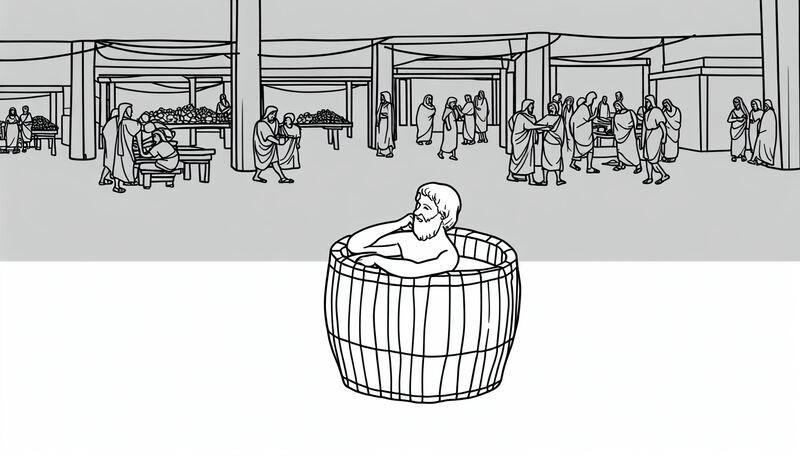
This is why Diogenes lived in a pithos — a large ceramic storage jar, the ancient equivalent of a shipping container. Not because he was too poor for a house. Because he wanted to prove a point: a jar keeps the rain off you the same as a penthouse. The penthouse is nomos. The dry patch of ground is physis.
Think about that the next time you're stressed about your apartment being too small or your car being last year's model. Diogenes would look at your studio apartment and ask why you need all that space.
Micro-practice: Pick one social obligation this week that you do purely out of convention — not because you want to, not because it serves anyone, just because That's What People Do. Skip it. See if civilization collapses. (It won't.)
Live Like an Animal (They Meant It as a Compliment)#
The Cynics got their name from kynikos — "dog-like." It started as an insult. They took it as a badge of honor.
Dogs don't pretend. Dogs eat when they're hungry, sleep when they're tired, bark at threats, wag at friends, and couldn't care less about your opinion of their personal brand. Dogs don't perform. Dogs just are.
"Other dogs bite their enemies," Diogenes said. "I bite my friends — to save them."
Living according to nature meant stripping life down to what your body and mind actually need, then training yourself to be content with exactly that. Diogenes rolled in hot sand in summer and hugged frozen statues in winter. Not because he was into suffering. Because he was training. The same way an athlete trains. Except instead of training for a marathon, he was training for freedom.
Every cold shower was a rep. Every skipped meal was a rep. Every night on hard ground was a rep. He was building the muscle that lets you look at everything the world offers — and everything the world threatens to take away — and genuinely not flinch.
Micro-practice: Tomorrow morning, take thirty seconds of cold water at the end of your shower. Not because cold showers are magic. Because that flinch you feel? That's the gap between what you need and what you're used to. The Cynics lived in that gap. It's smaller than you think.
Radical Honesty, or: Say the Thing Everyone's Thinking#
Parrhesia — frank, fearless speech — was the Cynic weapon of choice. Not polite disagreement. Not "I hear what you're saying, but have you considered..." Not a carefully workshopped email with three people cc'd. Just the truth. Out loud. To whoever needed to hear it. Regardless of what it cost.
Diogenes told Plato his lectures were a waste of time. He told Alexander to get out of his light. He told random Athenians in the marketplace that they were sleepwalking through their own lives. He didn't do it to be mean. He did it because he thought the truth was medicine, and most people were sick, and nobody else was willing to write the prescription.
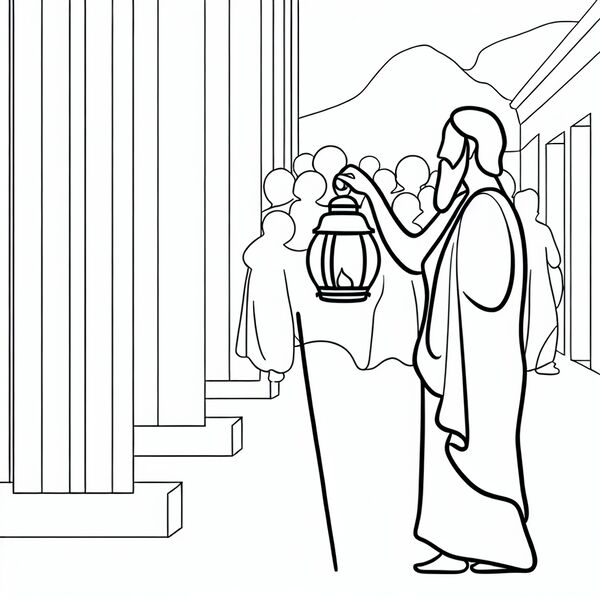
This is the guy who walked through Athens in broad daylight holding a lit lantern, telling everyone he was "looking for an honest man." He never found one. That was the point. Imagine someone doing that today — walking through a WeWork or a networking event or a political rally, holding up a flashlight, saying I'm looking for a single person here who isn't performing.
You'd call them crazy. You'd also know they were right.
Micro-practice: Today, say one true thing you'd normally swallow. Not cruel — true. Tell your friend their startup idea has a problem. Say "I don't know" in a meeting instead of bluffing. Admit you didn't read the article everyone's debating. Watch how nothing bad happens. Watch how the air gets a little easier to breathe.
Shamelessness as a Spiritual Practice#
If parrhesia was about what the Cynics said, anaideia — shamelessness — was about what they did.
Diogenes ate in the marketplace. He relieved himself in public. He performed every private act in the open and, when people freaked out, shrugged: "Why hide what is natural?"
Every time you cringe at that, ask yourself: why? Every bodily function he performed in public is one you perform in private. The act is identical. The only difference is who's watching. So the shame isn't about the act — it's about the audience. And if your behavior changes based entirely on who's watching, what does that say about the behavior? What does that say about you?
The Cynics understood something that took philosophy another two millennia to articulate: you can't argue people out of their conditioning. You have to show them. You have to do something so startling that the invisible becomes visible, that the water the fish are swimming in suddenly becomes obvious.
Every act of Cynic shamelessness was performance art with a thesis statement: If this is natural, why are you ashamed? And if the shame is artificial, what else in your life is artificial too?
The Greatest Hits: Stories That Still Slap After 2,300 Years#
The Plucked Chicken Incident (a.k.a. The Greatest Philosophical Dunk in History)#
Plato, in one of his tidier moments, defined a human being as "a featherless biped." His students nodded. Elegant. Logical. Publishable.
Diogenes heard about this. He found a chicken. He plucked it. He marched into Plato's Academy — the Harvard of the ancient world — held up the shivering, plucked bird, and announced: "BEHOLD! PLATO'S HUMAN!"
Plato, to his credit, amended his definition to include "with broad, flat nails."
It might be apocryphal. I don't care. It's the purest distillation of the Cynic method ever recorded. Plato built downward from abstraction. Diogenes threw a raw, squawking, featherless reality in the face of theory and said: Deal with this.
It's the same energy as someone replying to a CEO's inspirational LinkedIn post with a screenshot of their company's Glassdoor reviews. Theory, meet reality. Reality bites.
The Slave Auction (or: Who Actually Owns Whom?)#
Diogenes got captured by pirates at some point. (This happened more often in the ancient world than you'd think.) They dragged him to a slave market in Crete and put him on the auction block.
The auctioneer asked what he could do. Diogenes said: "Govern men."
Then he spotted a wealthy Corinthian named Xeniades in the crowd, pointed at him, and said: "Sell me to that man. He needs a master."
Xeniades bought him. Diogenes proceeded to run his household and educate his children so effectively that Xeniades told people he'd bought himself "a guardian spirit."
The man in chains was freer than the man holding the receipt. That's not a metaphor. That's what actually happened. Freedom isn't a legal status. It's not a bank balance. It's a condition of the mind. And you can't buy it, sell it, or take it away from someone who's done the work.
The Lantern at Noon#
Diogenes wandering through the marketplace in broad daylight, holding a lit lantern, telling everyone he was "looking for a human being" — not a person, a human being, someone truly awake, truly virtuous, truly alive.
He never found one.
That image has been painted, sculpted, memed, and referenced for over two thousand years, and it still works because it still applies. Walk through any shopping mall, any conference, any Instagram feed, any nightclub. Everyone performing. Everyone curating. Everyone selling a version of themselves they assembled from parts. And somewhere underneath all the performance, the actual human being — if there is one — is buried so deep even they can't find it anymore.
That lantern is still lit. It's just harder to see now because there's so much other light competing with it.
Crates and Hipparchia: The Most Punk Rock Love Story Ever Told#
This one's important. Because if Cynicism were only about one eccentric guy in a jar, you could write it off as a personality quirk. But Cynicism survived Diogenes. It grew. And the story of how it grew is also one of the most extraordinary love stories you've never heard.
Crates of Thebes (roughly 365–285 BC) inherited a fortune. He was wealthy enough to never work a day in his life. After encountering Cynic philosophy — the details vary; maybe he saw a play about a beggar-king, maybe he met Diogenes, maybe he just woke up one morning and the weight of his possessions became unbearable — he gave it all away.
All of it.
One account says he deposited the money with a banker and left instructions: if his kids turn out ordinary, give them the cash. If they become philosophers, distribute it to the poor, because philosophers don't need anything.
Then he moved to Athens and lived on the streets.
Here's the thing about Crates that made him different from Diogenes: he was gentle. Diogenes was a flamethrower. Crates was a campfire. He was physically deformed — hunched back, lame leg — but so warm, so funny, so genuinely kind that the Athenians loved him. They called him "the Door-Opener" because he'd walk uninvited into homes where families were fighting and just... fix it. Calmly. With jokes and wisdom and the total absence of judgment. Plutarch said Crates "laughed out his life jocosely, as if he had been always at a festival."
A homeless man with a bad back. Happier than anyone in the city. Sound familiar?
Then Hipparchia showed up and made the whole story more interesting.
Hipparchia of Maroneia was born around 350 BC, from a wealthy Thracian family that had relocated to Athens. Her brother Metrocles became one of Crates's students. Through her brother, Hipparchia met Crates. And she fell in love. Not the polite, arranged-marriage, socially-acceptable kind of love. The blow-up-your-entire-life kind.
Her parents were horrified. A wealthy young woman throwing herself at a homeless cripple? They begged Crates to discourage her. Crates, being honest to his bones, stood in front of Hipparchia, took off all his clothes, and said: "Here is the bridegroom, and this is his property. Decide accordingly."
She chose him.
Let me say that again. In a society where respectable women were essentially furniture — confined to the household, barred from public life, defined entirely by their fathers and husbands — Hipparchia looked at a destitute, unconventional street philosopher and said: Yes. This. This is the life I want.
She traded her silk for a rough cloak. She lived on the streets with Crates. They ate in public, slept under porticoes, and — according to multiple ancient sources — refused to hide anything natural behind closed doors.
She attended philosophical symposia. She debated men who had never been challenged by a woman in their lives. When the philosopher Theodorus tried to humiliate her by yanking up her garment in public, she didn't flinch. When he sneered — "Who is this woman who has left behind the shuttles of the loom?" — she fired back:
"I, Theodorus, am that person. But do I appear to you to have come to a wrong decision, if I devote that time to philosophy which I otherwise should have spent at the loom?"
Twenty-three centuries before feminism had a name, Hipparchia was living it on a street corner in Athens.
An epitaph attributed to her:
I, Hipparchia, chose not the tasks of rich-robed woman, but the manly life of the Cynic. Brooch-clasped tunics, well-clad shoes, and perfumed headscarves pleased me not. But with wallet and fellow staff, together with coarse cloak and bed of hard ground, my name shall be greater than Atalanta: for wisdom is better than mountain running.
She is the only woman with her own entry in Diogenes Laërtius's Lives and Opinions of Eminent Philosophers, the most important biographical source for ancient philosophy. One woman in the whole book. And she earned it not by marrying the right person or inheriting the right name, but by choosing the hardest possible path and walking it without apology.
Micro-practice: Think about the last time you didn't do something you wanted because of what people would think. Not something harmful — something genuinely good that you held back on because the optics were wrong. That gap between what you want and what you perform? That's the gap Hipparchia closed in a single afternoon. You don't have to shock people in a marketplace. You just have to stop letting the audience direct the movie.
"But That's Crazy" — And Other Things People Say When They're Uncomfortable#
"They were just homeless people with a philosophy degree."#
Crates gave away a fortune. Diogenes was educated, witty, and sharper than anyone in the room. These weren't people who couldn't hack it in society. They were people who hacked society, understood exactly how the code worked, and opted out. There's a canyon of difference between "can't" and "won't." Confusing the two is a defense mechanism. It's easier to call them crazy than to wonder if they were right.
"Modern cynicism proves the philosophy was a dead end."#
Modern cynicism — the everything-sucks, nobody-means-it, trust-nothing shrug — is the exact opposite of what the ancient Cynics believed. The originals were wildly optimistic. They thought human beings could be genuinely virtuous, genuinely free, genuinely happy, right now, with nothing but their own minds. Modern cynicism is about giving up. Ancient Cynicism was about waking up.
The word got stolen. That's not the Cynics' fault. That's like blaming punk rock for pop-punk.
"Easy for a privileged Greek man to say."#
This is a fair hit, and it deserves a real answer. Diogenes was a man in a culture that tolerated male eccentrics. But Hipparchia proves the philosophy wasn't boys-only. And Diogenes explicitly rejected every privilege available to him — citizenship, ethnicity, class. He called himself a kosmopolitēs, a "citizen of the world" — literally inventing the concept of cosmopolitanism. He didn't benefit from the systems he criticized. He burned them down and lived in the ashes.
"Nobody can actually live like this."#
You're right. You shouldn't move into a ceramic jar. That's not the ask.
The ask is: How many of your anxieties are about things that genuinely don't matter? How much of your suffering is about wanting things you don't need? How much of your life is a performance for people who aren't even paying attention?
You don't need to go full Diogenes. Go five-percent Diogenes. That five percent will change more than you expect.
Why You Need This Philosophy Right Now (Yes, You, in 2026)#
We're drowning in exactly the kind of noise the Cynics spent their lives fighting. They just didn't have a word for the algorithm yet.
Social media is a convention factory running at industrial scale. Every platform is engineered to make you care desperately about things that have zero connection to your actual wellbeing. Likes. Followers. Engagement metrics. The curated highlight reel of a stranger's life. Diogenes would look at your Instagram feed the way he looked at Plato's Academy: a lot of effort spent on something that isn't real.
Consumer culture is anti-Cynic propaganda. The entire global economy depends on you believing a lie: that you don't have enough. That the next purchase will fix the thing that's broken. That satisfaction lives in the next upgrade. The Cynics had a one-line rebuttal: You already have enough. You had enough before you started wanting more.
Status anxiety is the modern typhos. The Cynics called it typhos — literally "smoke." The fog that makes you chase titles, neighborhood prestige, school rankings, car brands, and the thousand other things that feel urgent but mean nothing. The cure was atuphia — seeing through the smoke. And brother, there has never been more smoke than there is right now.
Everyone is performing their values instead of living them. Posting the right takes. Sharing the right causes. Curating the right aesthetic of moral seriousness. The Cynics would ask the question nobody wants to hear: Are you actually living according to your values, or are you just broadcasting them?
There's a reason Diogenes memes go viral every other week. There's a reason every post about "the philosopher who lived in a jar" blows up on Reddit. Something about that image — a man with nothing, needing nothing, afraid of nothing — cuts through the noise in a way that no productivity hack or self-care routine ever will.
He's the guy who shows up to the black-tie gala in cargo shorts. He's the one reply under the billionaire's inspirational tweet that says "you got rich from your dad's emerald mine, sit down." He's the friend who tells you the truth about your relationship when everyone else is being supportive. He's every minimalist who figured out that owning less is freedom before it became a Pinterest aesthetic.
He's uncomfortable. He's inconvenient. And he's the most free person in every room he enters.
The Cynic Toolkit: Things You Can Actually Do#
These aren't saved for the end like a polite appendix. They're threaded through this whole piece because that's how the Cynics operated — philosophy isn't something you read about and then get back to normal life. It's something you do. But here are a few more:
The Subtraction Experiment#
Pick one thing you "need" and ditch it for a week. Not food or shelter — something you've been told is essential. A streaming service. The news. Alcohol. Your phone for the first hour of every day. Pay attention to what you actually miss versus what you expected to miss. The gap between those two is the size of the lie you've been sold.
The Convention Audit#
Once a day, pick any social norm and ask: Why? Why do I mow a lawn nobody uses? Why do I wear uncomfortable shoes to impress people I don't like? Why am I going to this event I'll hate? You don't have to violate the norm. Just seeing it is the first step. Fish can't critique water until they know they're wet.
The Diogenes Walk#
Go outside with no destination, no headphones, no shopping list. Just walk through your city and look. Count the advertisements you pass. Watch the people rushing. Ask yourself what they're rushing toward, and whether they'd know if they got there. This is the modern lantern. You don't need a prop. You just need your eyes open.
The Comfort Rep#
One uncomfortable thing per day. Cold water. Skipped meal. Sit on the floor. Walk in the rain without an umbrella. Not to punish yourself — to close the gap between what you need and what you're used to. Every comfort rep makes the gap smaller. Small enough, eventually, that the world runs out of threats.
Daily Rituals for the Semi-Feral Philosopher#
Morning: Before you touch your phone — before the notifications, the emails, the news cycle that wants to hijack your nervous system — ask one question: What do I actually need today? Not want. Need. The list is always shorter than you think. Let that be the ground you stand on.
Midday: Eat one simple meal. Not Instagrammable. Not optimized. Just food. Notice it. Taste it. Diogenes was perfectly content with lentils. You have access to every cuisine on Earth delivered to your door, and you're less content than a man who ate lentils from a bowl he threw away because he saw a child drinking from cupped hands.
Evening: The Cynic audit. Five minutes. How much of today was real? How much was performance? How much was spent on things I'll forget by Thursday? No judgment. Just looking. The looking is the practice.
Weekly: Give something away. Not something you don't want — something you like. A book you love. A jacket that fits perfectly. Feel the sting, and then feel the lightness that comes after. That's what Crates felt the day he gave away everything. A little version of it is available to you every week.
The Words Themselves#
Not as decorative quotes. As weapons, in context.
"I am a citizen of the world." — Diogenes, when asked where he was from. First recorded use of the word "cosmopolitan." In a culture where your city-state was your identity, he rejected the entire framework. Nationality? Nomos. Humanity? Physis.
"Stand a little out of my sunlight." — Diogenes to Alexander. A man with nothing asking a man with everything for the one thing empires can't provide: to not be in the way.
"He has the most who is content with the least." — Diogenes. Eight words. The entire philosophy. Tattoo it somewhere.
"It is the privilege of the gods to want nothing, and of godlike men to want little." — Diogenes. Your Amazon cart is the distance between you and divinity.
"I'd rather be mad than feel pleasure." — Antisthenes. Not a rejection of joy. A rejection of the cheap, manufactured, keep-you-docile pleasures that society pushes like a dealer on every corner.
"Sell me to that man. He needs a master." — Diogenes, at the slave auction. Ownership is cosplay. The free mind can't be chained.
"I, Hipparchia, chose not the tasks of rich-robed woman, but the manly life of the Cynic... for wisdom is better than mountain running." — Hipparchia's epitaph. A life defined by refusal, summarized in defiance.
"We have two ears and one tongue so that we would listen more and talk less." — Diogenes. Even the Dog knew when to shut up.
Where Cynicism Went Next (And Where It's Been Hiding)#
Cynicism → Stoicism. This is the big domino. Crates taught Zeno of Citium. Zeno went on to found Stoicism — the most influential philosophical school in the Western world. The Stoics kept the Cynic emphasis on virtue, nature, and cosmopolitanism, but filed down the sharp edges. They said you could be good and participate in society. Someone once called Cynicism "the short path to virtue" and Stoicism the scenic route. Same destination, different tolerance for sleeping in a jar. (See: Stoicism)
Cynicism → Early Christianity. The parallels are hard to ignore. Jesus telling rich men to give away everything. The wandering lifestyle. The confrontations with authority. The parrhesia. Cynic preachers were common in first-century Galilee. Scholars fight about whether there's a direct line of influence. The resonance, at minimum, is uncanny.
Cynicism → Existentialism. Diogenes was doing authenticity before Sartre smoked his first cigarette. Live by your own values. Reject the script society hands you. Accept that freedom is terrifying and choose it anyway. Same song, different century, fewer berets.
Cynicism → Minimalism. Marie Kondo is Diogenes for people who still want nice shelving. "Does this spark joy?" is a gentler version of "Does this actually serve your life, or are you keeping it because convention says you should?" The Cynics asked it first. They just didn't fold anything.
Cynicism → Punk Rock / Counterculture. The Cynics were the original punks. Reject mainstream values. Live outside respectable society. Use shock as a tool of liberation. The Beats, the hippies, the Occupy kids — every counterculture movement since Athens has been running the Cynic playbook whether it knows it or not.
Start Here#
One thing to read. One thing to do. One thing to remember.
Read: Book VI of Diogenes Laërtius's Lives of the Eminent Philosophers. It's short. It reads like a gossip column about the most interesting people who ever lived. Get the Penguin or Oxford translation. You'll laugh out loud on a bus and not care who sees you.
Do: Tomorrow morning, before anything else, ask: If I stopped trying to impress a single person, what would I do differently today? Write down the answer. Then do one thing on that list.
Remember: A man lived in a jar. He owned nothing. He insulted emperors to their faces. He was captured by pirates, sold as a slave, and ran his owner's household. He walked through a city of a quarter million people holding a lantern at noon, looking for one genuine human being, and never found one. And by every account we have — from his enemies as well as his friends — he was one of the happiest people anyone had ever met.
He didn't need anything the world was selling.
Books: If You Want to Go Deeper#
📖 "Lives and Opinions of Eminent Philosophers" by Diogenes Laërtius — The primary source. Book VI is the Cynics. Gossipy, contradictory, unreliable, and the most fun you'll ever have reading ancient philosophy. Robin Hard translation (Oxford World's Classics) for readability.
📖 "The Cynics: The Cynic Movement in Antiquity and Its Legacy" edited by R. Bracht Branham and Marie-Odile Goulet-Cazé — The serious academic treatment. Dense. Rewarding. For when the stories aren't enough and you want to understand the philosophy underneath.
📖 "Diogenes the Cynic: The War Against the World" by Jean-Manuel Roubineau — The best modern biography (2023). Separates legend from history while respecting both.
📖 "The Cynic Philosophers: From Diogenes to Julian" translated by Robert Dobbin (Penguin Classics) — The Cynics in their own words, or as close as we'll ever get. Essential primary source anthology.
📖 "Walden" by Henry David Thoreau — Not about Cynicism. Is about Cynicism. Thoreau is Diogenes with better prose and a pond instead of a jar.
The lantern is still lit. It's been burning for twenty-three centuries. Not in a museum. Not in a textbook. In that small, uncomfortable voice at 2 AM that asks: Is any of this real? Is any of this mine? Or am I just performing someone else's idea of a life?
Diogenes couldn't answer that for you. Neither can I.
But he did prove one thing, with his whole body and his whole life: you can put the performance down. You can stop. Right now. Today. You won't die. You might lose some things that turn out not to be yours. You might gain something that no one can take.
The jar is still empty. The sun is still free.
What are you standing in the way of?
Related Houses: Stoicism · Existentialism · Buddhism · Epicureanism
Talk about it · 4 questions
- Which of your goals come from your own values, and which come from what others expect?
- Is it ever right to break social rules to make a point, as Diogenes did?
- Cynicism led to Stoicism. What did the Stoics keep, and what did they soften?
- How is ancient Cynicism different from the modern word "cynical"?