The Ink Wing · Japanese Aesthetic
Wabi-Sabi
Your cracks are showing. Leave them.
A warlord came to see a famous garden. Every flower had been cut. Inside the tea room, one morning glory trembled in a vase. The master had destroyed an entire garden so a single flower could actually be seen. Wabi-sabi walks toward the chipped, the faded, the beautifully incomplete — because decay isn't the enemy, it's the art.
In 5 minutes
Wabi-sabi is the Japanese way of seeing beauty in things that are simple, old, imperfect and changing.
- Imperfection and ageing are part of beauty, not mistakes to hide.
- Sen no Rikyū made simple, humble things the heart of the tea ceremony.
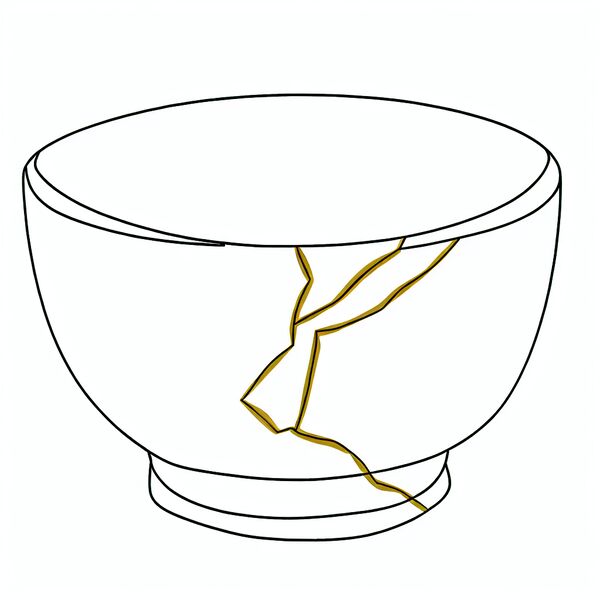
- Kintsugi repairs broken pottery with gold, making the crack part of its story.
Try today: Find one worn or chipped object you own and look at it for two minutes, noticing its history.
Before you go in…
One small question at the door. No right answers, just yours, and then how Wabi-Sabi would reason about it.
Your phone screen has had a crack for months. You could replace it this weekend. Is it damage to fix, or part of something you've grown to like?
Content note: This room discusses death and suicide. If you're struggling, help is here — Tele-MANAS 14416 (India) · findahelpline.com.
The Dictator and the Flower#
Sometime in the late 1500s, the most powerful man in Japan got angry about a garden.
Toyotomi Hideyoshi — warlord, unifier of nations, collector of everything beautiful — had heard about Sen no Rikyū's morning glories. Travelers were stopping in the road to stare at them. Blue and purple and white, spilling over the walls, the kind of abundance that makes your chest hurt a little. Hideyoshi wanted to see them the way he wanted everything: immediately, completely, on his terms.
He arrived. The garden was bare. Every vine cut. Every bloom gone. Just dark soil and silence.
Picture the fury. This man had armies. He didn't visit people's homes to look at dirt.
Rikyū bowed. Said nothing. Led him through a doorway so small the warlord had to crawl — and inside the tea room, in the half-dark alcove, one morning glory trembled in a bamboo vase.
One.
Rikyū had destroyed an entire garden so that a single flower could actually be seen. Not glanced at. Not scrolled past. Seen — the way you see something when there's nothing else competing for your attention.
I think about this story every time I open my phone. Forty-seven notifications, six group chats, an inbox like a landfill, and somewhere in there is the one message that actually matters. But I can't find it because I never cut anything down. I just keep adding more morning glories until the whole garden is noise.
Wabi-sabi starts here. Not with a philosophy lecture. With a pair of garden shears and the terrifying question: what would I see if I stopped looking at everything?
The Man Who Made Poverty Beautiful (and Was Killed For It)#
To understand what Rikyū was doing, you need to understand the world he was wrecking.
Sixteenth-century Japanese tea culture was Instagram before Instagram. The ceremony — chanoyu — had become a status game for warlords. They competed over rare Chinese porcelain the way tech founders compete over art collections. A single tea caddy could buy a castle. The bowls were flawless. The rooms were gilded. The whole performance said one thing: look how much I have.
Sound familiar? It should. We live in the same world. Different century, same sickness. Curated apartments, curated feeds, curated faces. Everything polished until it gleams. Everything performing its own perfection.
Into this walked a merchant's son from a port town. Nobody special. Rikyū started studying tea at seventeen, trained in Zen at Daitoku-ji temple, and somewhere along the way had an idea so radical it reads like vandalism:
He threw out the Chinese porcelain.
Instead, he commissioned bowls from Chōjirō — a tile-maker. Not an artist. A guy who made roof tiles. The bowls were hand-shaped, lopsided, rough. Pulled from the kiln still glowing. Each one warped differently. Fingerprints baked into the clay.
He replaced gilded tea rooms with grass huts. His most famous room, Tai-an, was six feet by six feet. The entrance was a square hole so low that samurai had to remove their swords and crawl through on their knees.
In a culture built on hierarchy, Rikyū built a doorway that made powerful men bow.
He used bamboo instead of bronze. Carved wood instead of ivory. He let silence fill the room where small talk used to live. And people — not everyone, but the ones who were paying attention — felt something crack open inside them.
What Rikyū was teaching wasn't aesthetics. It was perception. He was saying: you've been staring at gold for so long you've forgotten what your hands feel like. Here. Hold this rough, warm, imperfect bowl. Feel its weight. Feel where the glaze pooled and where it didn't. Feel the fact that no one will ever make another one exactly like this, that the person who shaped it left their thumbprint in the clay, that this object will outlast you and eventually it won't outlast anything.
Feel that. That's beauty.
Try this, right now. Pick up whatever you're drinking from. Coffee mug, water glass, whatever. Feel its weight. Run your thumb along the rim. Is there a chip? A stain? That's not damage. That's a Tuesday morning six months ago. That's the time you set it down too hard because someone texted you something that made you laugh. That's history.
The Bowls That Started Everything#
In the 1580s, Rikyū found Chōjirō and together they made something that shouldn't have worked. These raku bowls — the name literally means "enjoyment" — were hand-shaped from rough clay, fired at low temperatures, and yanked from the kiln while still glowing. No potter's wheel. No precision. The thermal shock crackled the glaze in random patterns. Each bowl warped differently. Some came out lopsided. Some had bubbles. Some had colors nobody planned for — a streak of copper green where the flame licked the surface, a patch of bare clay where the glaze crawled away from the heat.
These were not expensive. They were not refined. They were not Chinese. A tea master choosing them over imported porcelain was like a Michelin-starred chef serving dinner on a plate his neighbor made in a garage kiln.
And Rikyū declared them the highest expression of beauty.
He was saying something that still feels radical: beauty doesn't come from control. It comes from honesty. The raku bowl carries the evidence of its own making — the potter's thumbprint, the fire's mood, the glaze's unpredictable behavior. It hides nothing. It pretends nothing. It's just there, warm and rough and real, and when you hold it you're holding every accident that went into its becoming.
The Raku family is now in its sixteenth generation. They still make bowls by hand, one at a time, in Kyoto. And those bowls — born from Rikyū's insistence that imperfection was not a flaw but a language — are now among the most valuable ceramics on earth. Which is ironic in a way Rikyū would probably find funny. Or infuriating. Possibly both.
How the Story Ends#
It ends badly. It always ends badly when someone tells the powerful that their gold is ugly.
By the late 1580s, Rikyū was Hideyoshi's most trusted advisor on matters of taste. But the relationship was a lit fuse. The tea master who worshipped simplicity, serving the warlord who had once built an entire tea room out of gold leaf. One man who believed beauty was in letting go. Another who believed beauty was in owning everything.
Historians argue about what finally snapped. Maybe Rikyū refused to give his daughter to Hideyoshi. Maybe he was caught profiteering on tea equipment. Maybe he placed a statue of himself at a temple gate where Hideyoshi would walk beneath it in sandals — an insult so quiet it was deafening.
Or maybe it was simpler than that. Maybe Hideyoshi looked at Rikyū's stripped-down rooms and empty gardens and finally understood: this man thinks my golden tea room is tasteless. This man has been teaching people that everything I am is noise.
On April 21, 1591, Rikyū was ordered to commit seppuku. He was sixty-nine.
The accounts say he held one last tea ceremony. Served each disciple. Gave away every piece of equipment as a parting gift. Kept one thing — his tea bowl.
After the last guest left, he looked at the bowl. Said a poem. Then broke it. Smashed it so that no one could ever drink from it again.
Welcome to you, O sword of eternity. Through Buddha And through Daruma alike You have cleft your way.
His last act on earth was destroying the thing he loved most, so that it couldn't be turned into a possession. So that it stayed his — not as property, but as a moment that had already passed.
There's a lesser-known story about a bowl called Bakōhan that I can't get out of my head. It was a Chinese tea bowl that cracked and was sent for repair. It came back held together with crude metal staples — clamps so big they looked like locusts clinging to the ceramic. Ugly. Graceless. The kind of repair you'd normally hide in the back of a cabinet.
Instead, the repaired bowl became a treasure. They named it after the locust-clamps. The ugliness of the honest repair was more inspiring than any attempt to restore it to its original state. The damage wasn't hidden. It wasn't beautified with gold. It was just... there. Blunt and real. And the Zen sensibility of the time looked at it and said: yes. This.
I think about Bakōhan when people tell me to "focus on the positive" or "look on the bright side." Sometimes the repair isn't golden. Sometimes it's ugly metal staples holding you together. And that's okay. You're still held. You're still whole. The beauty doesn't have to be pretty.
I think about this when I'm afraid to delete old photos. When I keep screenshots of conversations with people who are gone. We hold onto things because we think they hold the moment. But the moment is already broken. It broke the second it happened. Rikyū knew that. His last teaching was: let it break.
The Two Words That Contain a Universe#
I keep circling back to the language itself.
Wabi (侘び) originally meant something close to misery. Desolation. The loneliness of being out in nature, stripped of status and comfort, alone with nothing. Over centuries — through tea, through Zen, through poets who found something shimmering in the emptiness — the word transformed. It came to mean the beauty inside simplicity. Not glamorized poverty. The real thing: the moment when you've lost everything extra and what's left is enough.
You know the feeling. You've had it. That night you couldn't sleep and you walked into the kitchen at 3 AM and just stood there in the dark drinking water and for some reason the silence felt like the most honest moment you'd had in weeks. That's wabi. The beauty of having nothing to perform.
Sabi (寂) meant loneliness, withering. It shares a root with the word for rust. Over time it became the beauty of age — the green of oxidized copper, the smooth grain of a wooden step worn by decades of feet, the silver threading through someone's hair. Not despite the aging. Because of it.
Together they're not an aesthetic choice. They're a way of seeing. You don't need a Japanese tea bowl to practice wabi-sabi. You need to look at the mug you already own — the one with the tea stain that won't come out — and see it differently. Not as damaged. As seasoned.
The Three Truths You Already Know#
Richard Powell boiled it down to nine words: "Nothing lasts. Nothing is finished. Nothing is perfect."
You already know this. You've known it since the first time something you loved broke, or left, or changed. Wabi-sabi didn't invent these truths. It just had the nerve to call them beautiful.
Nothing lasts. The Buddhist word is mujō — impermanence. Everything you're touching right now is in the process of becoming something else. Your body is replacing its cells. Your coffee is getting cold. The sunlight on your wall is moving. The person you were this morning isn't quite the person reading this sentence.
Cherry blossoms are the cliché example, but here's a better one: the playlist your ex made you. You can't listen to it anymore, not really. Not without feeling that specific ache of something that was alive and isn't. But you haven't deleted it either, have you? Because the ache is part of it now. The songs aren't just songs. They're a season of your life, pressed into sound, and the fact that the season ended is what makes it hurt, and the hurt is what makes it matter.
That's impermanence. Not "everything dies, so whatever." More like: "everything dies, so pay attention."
Nothing is finished. The Zen garden at Ryōan-ji temple in Kyoto has fifteen stones on raked gravel. From any spot you stand, you can only see fourteen. The fifteenth is always hidden. They built it that way on purpose.
You will never see all the stones. You will never read all the books. You will never be the finished version of yourself. Your apartment will never be "done." Your understanding of someone you love will never be complete. And this isn't failure — this is what being alive actually feels like. Everything is mid-sentence. Including you.
Nothing is perfect. Here is where wabi-sabi gets dangerous. Because Western culture — Greek temples, Renaissance paintings, Instagram filters, teeth-whitening, six-pack abs, minimalist apartments that look like nobody lives in them — is organized around the idea that perfection exists and you should chase it.
Wabi-sabi says: perfection is a performance. And the performance is exhausting. And the thing you're performing for — the audience that demands your flawlessness — doesn't exist. It's just you, terrified that someone will see the cracks.
The crack in your phone screen that you've been meaning to fix for three months? You've started to like it a little, haven't you? The way the light catches the fracture lines. The way it doesn't stop the phone from working. The way it's yours — not the generic phone from the store, but this specific one that you dropped on that specific sidewalk on that specific night.
That's not damage. That's a life being lived.
The Art of Golden Scars#
If wabi-sabi is the philosophy, kintsugi is its most gorgeous argument.
Late fifteenth century. The shōgun Ashikaga Yoshimasa breaks his favorite tea bowl. Sends it to China for repair. Gets it back held together with ugly metal staples. He's horrified. Asks Japanese craftsmen to do better.
What they invented: they filled the cracks with lacquer mixed with powdered gold. The seams of breakage became seams of light. The repaired bowl wasn't restored — it was transformed. Its history of shattering became its most beautiful feature.
Collectors lost their minds. Some reportedly smashed bowls on purpose just to have them repaired with gold. The "broken" version was worth more than the "perfect" original.
I want to sit with that for a second. Because we do the opposite with people. Someone shows us their damage and we flinch. We tell them to "move on." We expect them to heal invisibly, to hide the seams, to perform unbrokeness. We say "you're so strong" when what we mean is "thank God you're not making me look at your cracks anymore."
Kintsugi says: no. Show me where it broke. Let me see the gold.
You are not less for having been broken. You are more for having been repaired.
Not because suffering is noble. Not because pain builds character. But because the repair is real, and reality is always more beautiful than the performance of having never been hurt.
Christy Bartlett wrote about kintsugi: "Not only is there no attempt to hide the damage, but the repair is literally illuminated... a kind of physical expression of the spirit of mushin." Non-attachment. Equanimity amid changing conditions. The bowl isn't pretending it was never broken. It's wearing its breaking like a crown.
Try this. Next time something breaks — a plate, a zipper, a seam — fix it visibly. Don't make it look like it never happened. Sew the patch on the outside. Glue the handle back with something you can see. Let the repair be part of the object's story. Then notice how it changes the way you feel about the thing. Notice that you love it more now. Notice that the repair made it yours in a way it wasn't before.
What This Isn't (A Short, Necessary Rant)#
I need to say this because the internet has turned wabi-sabi into a mood board, and it makes me want to throw a very expensive reclaimed-wood coffee table through a window.
Wabi-sabi is not:
- Deliberately distressed furniture from West Elm
- A $400 "imperfect" ceramic mug from a design boutique
- "Rustic charm" as a Pinterest category
- An excuse for not cleaning your apartment
If you designed the imperfection, it's not wabi-sabi. It's theater. If you bought the rusticity, it's not wabi-sabi. It's consumerism wearing a kimono.
Wabi-sabi is what you notice, not what you manufacture. The difference between wabi-sabi and "shabby chic" is the difference between the worn-out hoodie you've had since college — the one that's falling apart but you cannot throw away because it smells like a version of your life that doesn't exist anymore — and a brand-new hoodie that's been pre-faded to look vintage.
One has a story. The other is pretending.
And wabi-sabi is not nihilism. "Nothing lasts, so why bother?" is exactly backwards. Nothing lasts, so this is your only chance to see it. The impermanence isn't a reason for indifference. It's a reason to pay an almost unbearable amount of attention.
Some scholars — including Japanese ones — have pointed out that Westerners tend to gut wabi-sabi of its Buddhist roots and sell back the husk as a lifestyle brand. Fair. Without the awareness of mujō (impermanence), ku (emptiness), and dukkha (suffering) underneath it, wabi-sabi is just an aesthetic. The point was never to curate a beautiful life. The point was to see the beauty in your actual life — the messy, unfinished, slightly broken one you're already living.
Film Grain and Analog Hearts#
Here's something I keep noticing: people are choosing imperfection on purpose and they can't quite explain why.
Film photography is back. Not because it's better — it's worse in almost every measurable way. Blurry, grainy, unpredictable. You get 36 shots and half of them are garbage. But people are buying old Canons and Nikons and paying to develop film because digital photos feel too clean. Too perfect. A phone camera gives you 4K HDR computational photography that smooths every pore and optimizes every shadow, and it looks like nothing. It looks like content. Film grain looks like a memory.
Vinyl records. Same thing. Spotify has 100 million songs in lossless quality. Vinyl crackles, warps, skips, takes up space, costs more. People are spending hundreds of dollars on turntables because the crackle sounds like being alive. The imperfection isn't a bug. It's the signal.
Handwritten letters. Voice notes instead of texts. Baking bread from scratch when the store is three minutes away. Choosing the long way, the slow way, the way that leaves fingerprints.
None of these people are thinking about sixteenth-century Japanese tea masters. But they're doing something Rikyū would recognize instantly: refusing the flawless version because it doesn't feel like anything.
AI can write a perfect essay now. It can paint a perfect portrait, compose a perfect song. And something about that perfection feels hollow. Not because it's bad — it's technically flawless — but because nobody bled into it. There's no thumbprint in the clay. No crackle. No grain. The machine learned what beauty looks like from a million examples and averaged them all into something technically correct and emotionally empty.
You know what doesn't feel empty? Your friend's terrible guitar playing at 1 AM. Your mom's handwriting, which hasn't changed since 1987. The cake your kid made that looks like a crime scene but tastes like being loved.
Imperfection is the signature of a human hand. Take it away and you're left with product. Leave it in and you have art.
We're drowning in perfection and starving for texture. Wabi-sabi is texture. It's the grain in the photo, the crackle in the vinyl, the wobble in the hand-thrown mug, the pause in the middle of a sentence when someone you love is trying to say something true and can't quite find the words—
That pause. That's wabi-sabi.
The People You Love Are Going to Change#
Relationships might be where this matters most. And where it's hardest.
We start every relationship — romantic, friendship, family — with an image. The perfect partner, the ride-or-die friend, the parent who will never let you down. And then, slowly, the image cracks. They say the wrong thing. They forget something important. They have a whole inner life you didn't know about and some of it is ugly.
This is where most relationships fail. Not because of the crack, but because of the panic. We think the crack means the relationship is broken. We think broken means over.
Wabi-sabi says: the crack is where the relationship starts. Before the crack, you were in love with a performance. After the crack, you have a chance to love what's actually there.
The long marriage with its history of arguments, silent treatments, and slow repairs. The friendship that survived distance and the horrible thing one of you said in 2019 that you both pretend to have forgotten but haven't. The parent you've forgiven for something they still don't fully understand.
These are kintsugi relationships. Gold in the seams. Stronger where they broke.
Try this. Think of someone you love whose imperfections you usually try to fix or ignore. Their messiness. Their lateness. Their tendency to talk too much or not enough. For one week, try seeing those things as texture instead of damage. Not accepting bad behavior — wabi-sabi isn't a doormat — but noticing the difference between "this person is flawed" and "this person is real."
The Apartment That Nobody Sees#
While we're here: your living space. Look around.
I bet there's something in your home that you keep meaning to fix, replace, or hide. The water stain on the ceiling. The bookshelf that leans slightly left. The kitchen table with the ring mark from that time someone put a hot pan down without a trivet and you were annoyed for a day and then forgot.
You could fix these things. Or you could do something stranger: you could see them.
Every mark in your home is a record of something that happened. The scratches on the floor are the path your furniture took every time you rearranged the room because you were restless. The scuff on the wall is the height your kid was when they rode their bike indoors that one time. The faded spot on the couch is where the afternoon sun hits, where you've sat and read and napped and cried and stared at the ceiling trying to figure out your life.
Your home is not a showroom. It's a document. And the "flaws" are the most honest sentences in it.
Tadao Ando builds concrete buildings that show every imperfection — every bubble, every grain of the formwork. Axel Vervoordt designs interiors where the walls are allowed to be old, where the plaster cracks and nobody fills it in. They're not being lazy. They're saying the same thing Rikyū said with his grass hut and his bamboo vase: a space that performs its own perfection is a space where nobody can actually relax.
Try this. Choose one "flaw" in your home that you've been tolerating with quiet resentment. The chipped tile. The scratched countertop. The mismatched furniture. For one week, practice seeing it as a feature instead of a bug. Tell yourself its story. See if the resentment loosens.
The Worn Threshold#
The poet Matsuo Bashō named his house after a banana plant — Bashō-an, the banana-plant hut. Banana leaves are enormous and beautiful and they tear in the first strong wind. He chose that as his symbol. Beauty that can't survive its own weather.
His most famous haiku:
An old pond — a frog jumps in — the sound of water.
Seventeen syllables. Nothing dramatic. A frog. A pond. A sound. And somehow four hundred years later people are still sitting with it, still finding something they can't name, still hearing that small plop in the silence of their own reading.
That's wabi-sabi writing. Not the grand statement. The small true thing that resonates because you let it be small.
Leonard Koren, who wrote the first serious English-language book on wabi-sabi, said things wabi-sabi are "unstudied and inevitable looking... They do not bleat out 'I am important' the way big, brash, expensive things do."
Unstudied and inevitable. Like a stone worn smooth by a river. Like the way old couples finish each other's sentences — not as a performance, but because they've said everything so many times the words have worn grooves.
Before Rikyū turned it into a philosophy, wabi-sabi was just life. The farmer's thatched roof going soft in the rain. The stone lantern sinking into moss. The rice bowl chipped and still used every day, every day, every day, until the chip became invisible because it was just part of the bowl now.
Soetsu Yanagi, who founded the mingei — folk craft — movement, spent his life arguing that the most beautiful objects were the anonymous ones. The rice bowl nobody signed. The cloth nobody exhibited. The things made by unnamed hands for daily use, worn into beauty by the repetition of ordinary life. He would have hated the concept of a "statement piece." The whole point was that the most eloquent objects had nothing to state. They just were.
The beauty was there before anyone named it. It was there in the worn wooden threshold of every house where people had crossed in and out for decades, their feet slowly polishing the grain. Rikyū didn't invent wabi-sabi. He just pointed at the threshold and said: look. Look at where the living happened.
Your One Unfinished Life#
Here's what I think wabi-sabi is really about, underneath the tea bowls and the garden stories and the Japanese aesthetics.
It's about the terror of being seen.
We spend enormous energy making ourselves look finished. Polished résumés. Filtered photos. Rehearsed answers to "how are you?" We sand down our edges. We perform competence. We pretend we know what we're doing. And underneath all of it is the same fear: if they see the cracks, they'll leave.
Wabi-sabi says: the cracks are the most interesting thing about you.
Not because brokenness is romantic. Not because suffering is beautiful. But because the cracks are where you're honest. They're where the performance stops and the person starts. And the person is always more interesting than the performance.
You are not supposed to feel happy all the time. You are not supposed to have everything figured out. You are not supposed to be done. The fifteen stones at Ryōan-ji, remember? You can't see them all at once. That's not a flaw in the garden. That's the garden's entire point.
Your unfinished novel. Your unresolved grief. Your half-learned language. Your complicated relationship with your mother. The dreams you abandoned and the dreams you're still too scared to start. All of this is you — not the polished version, not the LinkedIn version, not the version that has it together. The real one. The one with the cracks showing.
Leonard Cohen sang it: "There is a crack in everything. That's how the light gets in."
He also sang: "Ring the bells that still can ring. Forget your perfect offering."
Forget your perfect offering. My God. If wabi-sabi had a national anthem, that would be it.
The Anxious Person's Guide to Letting Go#
There's a growing conversation — in therapy offices, on Reddit threads at 3 AM, in the quiet corners of self-help that haven't been colonized by hustle culture — about wabi-sabi as a framework for anxiety and depression.
The insight is simple, almost embarrassingly so: most of your suffering comes from comparing your reality to a perfection that was never available.
You're not supposed to feel happy all the time. Nobody does. The person on Instagram who looks like they do is lying — or medicated — or both. Happiness isn't a resting state. It's a weather pattern. It comes and goes and comes again and the spaces between are not failures. They're just the spaces between.
You're not supposed to have everything figured out. The Ryōan-ji garden again: fifteen stones, and you can never see them all. Your life is the same. There are always stones you can't see. Relationships you don't understand. Decisions that won't make sense for years. Parts of yourself that remain strangers. That's not a problem to solve. That's what a life feels like from the inside.
You're not supposed to be finished. You're not supposed to arrive. The whole idea that there's a destination — some future state where you'll finally be enough — is the lie that keeps you miserable. You're mid-sentence. You've always been mid-sentence. The sentence doesn't end. That's not failure. That's the grammar of being alive.
Andrew Juniper wrote that wabi-sabi objects bring about "a sense of serene melancholy and a spiritual longing." Serene melancholy. Not happiness. Not despair. Something in between — the bittersweet feeling of being alive in a world that's always changing. The Japanese call it mono no aware, the pathos of things. The ache you feel watching autumn leaves. The tenderness of holding someone's hand and knowing, somewhere underneath the warmth, that one day one of you will have to let go.
That ache isn't a bug. It's the feeling of paying attention to what's real.
Try this. Next time you catch yourself spiraling about something you should have done, should be, should feel — try replacing "should" with "could." Not "I should have my life together" but "I could have my life together, and I could also be exactly where I am, and both of those are just options, and one of them is real." Sit with the real one. See if it's as bad as the "should" was telling you.
Before You Close This Tab#
Don't turn this into a self-improvement project. Don't add "practice wabi-sabi" to your to-do list between "meal prep" and "meditate." That would be the most anti-wabi-sabi thing imaginable.
Instead: just one thing.
Tomorrow morning, before you check your phone — before you open the door to the noise — look at something. The light on the wall. The coffee in the cup. Your own hands, which have been through so much and are still here, still working, still reaching for things.
Look at it the way Hideyoshi looked at that single morning glory after Rikyū cut down the whole garden.
Not as one of a thousand things. As the only thing.
Notice that it's imperfect. Notice that it won't last. Notice that it's not finished.
Notice that you're not either.
And notice — if you're quiet enough, if you've cut away enough noise — that this is not a problem to be solved. This is what beauty actually looks like when it stops performing.
Antoine de Saint-Exupéry — a French pilot who crashed planes in deserts and wrote about little princes — once said: "Perfection is not when there is nothing more to add, but when there is nothing more to take away." He was talking about aircraft design. He could have been talking about Rikyū's tea room. He could have been talking about your life.
What if you've been adding morning glories when what you needed was to cut them down? What if the beauty was already there — in the one thing, the single bloom, the imperfect cup, the cracked ceiling, the person you are right now — and you just had too much noise to see it?
Rikyū knew. He cut down the garden. He broke the bowl. He crawled through the small door.
You probably won't do anything that dramatic. But maybe tonight you could hold your chipped mug a little longer. Maybe you could look at the crack in the ceiling and, instead of thinking I should fix that, think: that's where the house has been alive.
Maybe you could let one thing be broken and not fix it and see what happens.
I think what happens is you exhale.
I think what happens is you stop performing.
I think what happens is you see the morning glory.
"Though you wipe your hands and brush off the dust and dirt from the vessels, what is the use of all this fuss if the heart is still impure?" — Sen no Rikyū
Going Deeper#
📖 Wabi-Sabi: for Artists, Designers, Poets & Philosophers — Leonard Koren (1994). Slim, precise, gorgeous. Under 100 pages. Start here.
📖 The Book of Tea — Kakuzō Okakura (1906). Written in English by a Japanese scholar. Every chapter breathes wabi-sabi.
📖 In Praise of Shadows — Jun'ichirō Tanizaki (1933). An essay on darkness, patina, and the beauty of things that don't shine. Will change how you see your own house.
📖 Wabi Sabi: The Japanese Art of Impermanence — Andrew Juniper (2003). If you want the Buddhist roots, go here.
📖 Zen Mind, Beginner's Mind — Shunryu Suzuki (1970). The Zen beneath the wabi-sabi. "In the beginner's mind there are many possibilities; in the expert's mind there are few."
📖 The Narrow Road to the Deep North — Matsuo Bashō (1702). A travel journal that finds beauty in the smallest, most fleeting things. Reading it feels like watching light move across a room.
📖 The Unknown Craftsman — Soetsu Yanagi (1972). On the beauty of anonymous, everyday objects. The worn bowl. The mended cloth. The things no one signed.
Connections#
Zen Buddhism — Wabi-sabi is applied Zen. Impermanence, suffering, non-self — turned into a way of seeing.
Taoism — "The usefulness of a pot comes from its emptiness." Lao Tzu could have been describing Rikyū's tea room.
Stoicism — Marcus Aurelius: "Loss is nothing else but change." Different tradition, same nerve.
Talk about it · 4 questions
- Why did Rikyū cut every flower in the garden except one?
- How is wabi-sabi different from the "minimalist" style seen online?
- What does kintsugi teach about mistakes and healing?
- How could wabi-sabi change the way we see people who are getting older?